

.jpg)
Setting the Context
India’s General Anti‑Avoidance Rules (GAAR) were consciously designed as a backstop, a provision of last resort to neutralise abusive tax arrangements that, though compliant in form, are predominantly tax‑driven and devoid of commercial substance. They were never intended to become a routine overlay on every corporate restructuring, demerger or capital‑market transaction that incidentally yields tax efficiency.
Recent directions of the GAAR Approving Panel in relation to the Hinduja Group’s NCLT‑approved demerger involving NXTDigital and Hinduja Global Solutions Ltd, and the Vedanta Group’s Mauritius‑routed delisting structure, however, suggest a perceptible shift. GAAR is increasingly being invoked even where transactions have already traversed rigorous scrutiny under other statutory regimes such as the Companies Act and SEBI regulations. This development raises an important jurisprudential question: should every restructuring or delisting that results in a tax advantage be viewed through a presumption of avoidance, and what role should NCLT approval play in assessing commercial substance under GAAR?
GAAR: Purpose, Threshold & Restraint
Chapter X-A of the Income-tax Act, 1961 empowers the tax administration to disregard an “impermissible avoidance arrangement” where the main purpose of the arrangement is to obtain a tax benefit and it also satisfies one of the statutory tainted-element tests, including lack of commercial substance. The emphasis is deliberate: GAAR is triggered not by the mere presence of a tax benefit, but where the dominant purpose of the arrangement is tax avoidance.
This distinction is fundamental and has deep jurisprudential roots. Indian courts have consistently recognised that tax planning, per se, is not illegitimate. From Azadi Bachao Andolan to Vodafone International Holdings, the Supreme Court has cautioned against recharacterising bona fide commercial arrangements merely because they are tax-efficient. At the same time, McDowell reminds that colourable devices cannot be countenanced. GAAR was introduced to reconcile these strands, targeting abusive arrangements without unsettling legitimate commercial structuring.
CBDT’s GAAR guidance also reflects this balance, clarifying that GAAR is to be invoked only in clear cases of abuse and not where transactions are supported by commercial rationale, even if they result in tax benefits. Read in this light, GAAR is an exceptional power demanding restraint, precision and high-quality evidence.
The Hinduja Demerger: GAAR Meets an NCLT‑Sanctioned Scheme
In the Hinduja Group matter, the GAAR Approving Panel characterised the demerger and subsequent merger involving NXTDigital as an impermissible avoidance arrangement, notwithstanding the fact that the scheme had been sanctioned by the NCLT. The Panel’s reasoning, as publicly reported, focused on the timing of the restructuring, the availability of substantial brought‑forward losses in NXTDigital, and statements recorded from certain key managerial personnel suggesting absence of business synergies and an emphasis on tax outcomes.
A notable aspect of the order is the Panel’s clear articulation that the existence of some commercial rationale is not decisive; what matters is whether obtaining a tax advantage was the main purpose. Equally significant is the Panel’s express rejection of the argument that NCLT approval can operate as a bar to GAAR invocation, on the ground that the issues before the NCLT and the GAAR Panel operate in different statutory domains.
While this position is legally defensible, it also raises a deeper institutional concern: does treating NCLT approval as largely neutral evidence, risk eroding certainty in corporate restructurings that have already passed through an independent statutory filter?
Vedanta Delisting: GAAR at the Intersection of Treaty Law and Capital Markets
The Vedanta episode carries GAAR into the capital‑market arena. The Revenue has alleged that the Mauritius‑routed delisting structure was orchestrated to artificially satisfy the India–Mauritius DTAA shareholding threshold and secure a lower dividend tax rate. The GAAR Approving Panel’s approval of this approach is now under judicial scrutiny before the Delhi High Court, with the assessee also challenging compliance with GAAR’s procedural safeguards.
What makes the case significant is not merely the treaty‑shopping allegation, but the broader signal it sends: even transactions governed by SEBI’s delisting framework, designed to protect public shareholders and market integrity, are now vulnerable to GAAR‑based recharacterisation.
Judicial Signals: Recent High Court Guidance on GAAR
Recent High Court decisions provide valuable guidance on how GAAR is expected to operate in practice, reinforcing both the breadth of the power and the limits of its legitimate use.
A significant ruling in this regard is the Telangana High Court’s decision in Ayodhya Rami Reddy Alla v. PCIT dated June 7, 2024. The Court declined to interdict GAAR proceedings at the threshold, observing that GAAR may still be invoked even where specific anti-avoidance provisions are arguably applicable. The judgment underscores that GAAR’s procedural architecture under section 144BA is not a mere formality and should ordinarily be allowed to run its course where the Revenue alleges an arrangement structured with the dominant purpose of obtaining a tax benefit.
Equally important is the later decision of the same High Court in Smt. Anvida Bandi v. DCIT , dated 22 August 2025. In this case, the Court set aside GAAR invocation in relation to securities transactions carried out through regular market mechanisms, emphasising that GAAR cannot rest on suspicion, timing or outcome-based inference alone. The Revenue must first establish, with cogent material, the existence of an impermissible avoidance arrangement; the mere presence of tax efficiency or strategic sequencing does not suffice.
Read together, these rulings delineate a calibrated judicial approach. While Ayodhya Rami Reddy affirms that GAAR is a viable tool to examine alleged abusive arrangements, Anvida Bandi firmly polices the evidentiary threshold, cautioning against transforming GAAR into a hindsight instrument. For restructuring and delisting cases alike, the message is clear: GAAR may be invoked, but only on the strength of disciplined, arrangement-specific evidence demonstrating that tax benefit and not commercial reorganisation was the dominant purpose.
Does NCLT Approval Evidence Commercial Substance?
NCLT is a statutory tribunal tasked with supervising schemes of arrangement under the Companies Act. Its approval follows disclosures, valuation exercises, regulatory notices and stakeholder participation. From a taxpayer’s perspective, such approval reasonably evidences that the scheme is not a sham or colourable device under company law.
It is, of course, correct that NCLT does not adjudicate tax avoidance or apply GAAR. Yet, to treat NCLT approval as wholly irrelevant for GAAR purposes is equally problematic. A more principled position would recognise that while NCLT approval cannot confer immunity from GAAR, it should constitute strong persuasive evidence of commercial substance, shifting the evidentiary burden onto the Revenue to demonstrate, with contemporaneous and objective material, that tax benefit was the dominant purpose.
This approach accords with institutional comity and the constitutional requirement of certainty in taxation under Articles 14 and 265. When one statutory authority has already scrutinised and sanctioned a transaction, another authority invoking an exceptional power such as GAAR must do so with commensurate restraint and rigour.
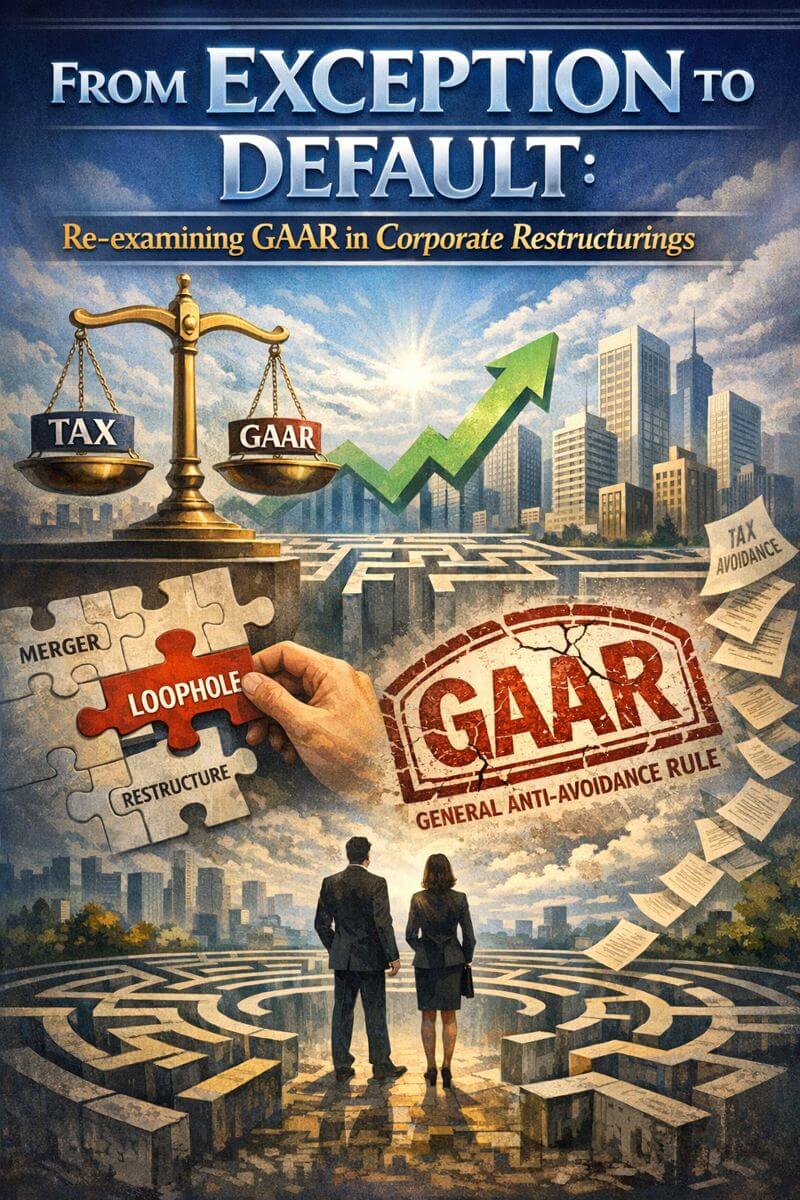
From Exception to Default? Re-examining GAAR’s Role in Corporate Restructurings
A discernible theme emerging from recent GAAR actions and judicial responses is the quiet but significant shift in perception - from GAAR as an exceptional anti-abuse measure to GAAR as a near-default lens through which corporate restructurings are examined. This shift is not doctrinally inevitable; rather, it appears to be driven by an increasing tendency to treat the presence of a sizeable tax benefit as a proxy for tax avoidance. Such an approach risks inverting GAAR’s statutory logic. The law requires the Revenue to establish that tax benefit is the dominant purpose of the arrangement, not for the taxpayer to prove that tax considerations played no role at all.
Corporate restructurings viz. demergers, mergers, hive-offs, delistings or internal reorganisations are, by their very nature, multi-dimensional. They are influenced by commercial, regulatory, financing, governance and risk-management considerations, often unfolding over extended timelines. To view these complex exercises through a single, tax-centric prism is to oversimplify corporate decision-making and to risk re-characterising legitimate business strategy as impermissible avoidance merely because it was efficiently structured.
The danger in allowing GAAR to morph into a default analytical tool lies not merely in increased litigation, but in the erosion of certainty. If even NCLT-approved schemes and SEBI-regulated transactions are perennially vulnerable to GAAR challenge, boards and investors are left navigating a landscape where finality is elusive and commercial decisions are perpetually exposed to hindsight review. GAAR’s legitimacy, therefore, depends as much on how often it is invoked as on how it is applied.
Establishing Commercial Substance: Guidance for Future Restructurings
As GAAR scrutiny increasingly extends to corporate restructurings, the focus for businesses and advisors must shift from merely achieving legal compliance to demonstrably establishing commercial substance as the dominant driver of the transaction. In a GAAR-sensitive environment, substance is not asserted, it must be evident, contemporaneous and enduring.
First, contemporaneous articulation of business rationale is critical. The commercial objectives of a restructuring should be clearly articulated at the inception stage and consistently reflected across board minutes, scheme documents, valuation reports and advisor presentations. Objectives such as operational focus, capital allocation efficiency, governance simplification, risk ring-fencing, regulatory alignment or preparation for strategic investment must be documented as the primary motivations. Where tax implications are discussed, they should appear as consequential outcomes, not as the organising principle of the transaction. A restructuring that appears to be “designed around” a tax event is far more vulnerable than one that incidentally optimises tax consequences.
Second, alignment between form and post-transaction conduct is indispensable.
GAAR analysis does not end with the legal structuring; it increasingly extends to post-transaction behaviour. If a demerger is undertaken to achieve business independence, such independence must be visible in governance, decision-making, funding arrangements and operational conduct after the restructuring. Any disconnect between stated objectives and subsequent conduct can quickly erode claims of commercial substance and invite adverse inference.
Third, sequencing must reflect commercial logic, not tax convenience. While complex restructurings often unfold in stages, the sequencing of steps should be defensible on commercial grounds. Transactions that appear timed primarily to absorb losses, offset gains or access treaty benefits are more likely to attract GAAR scrutiny. Where sequencing is commercially unavoidable, the reasons must be supported by objective material such as regulatory timelines, financing constraints or business exigencies.
Fourth, reliance on independent processes strengthens substance. Use of statutory mechanisms, such as NCLT-sanctioned schemes, SEBI-regulated routes, independent valuations and third-party fairness opinions—should be viewed as substantive safeguards rather than mere procedural compliance. While regulatory approval does not immunise a transaction from GAAR, it materially strengthens the narrative that the restructuring is embedded in recognised commercial and legal frameworks, rather than being a bespoke tax construct.
Finally, internal communications matter as much as formal documentation. Recent GAAR experience shows that statements of key managerial personnel, internal emails and advisor communications are increasingly relied upon by the Revenue. Care must therefore be taken to ensure consistency between internal deliberations and external positioning. Casual or isolated references portraying a restructuring primarily as a “tax planning” exercise can significantly undermine an otherwise robust commercial case.
In essence, future-ready restructurings must be commercially inevitable first, and tax-efficient second. Where commercial substance is real, documented and reflected in conduct, tax benefits naturally follow as a by-product. GAAR was never intended to penalise such outcomes—and a disciplined approach to establishing substance is the most effective way to ensure that it remains so.
Conclusion
The recent GAAR developments arising from corporate restructurings and delisting transactions underscore an evolving phase in India’s anti-avoidance jurisprudence. The Hinduja and Vedanta matters mark an inflection point in India’s GAAR jurisprudence. They reflect a growing willingness on the part of the tax administration to closely examine transactions that yield significant tax outcomes, even where such transactions are undertaken within established statutory frameworks. While this evolution is not, in itself, inconsistent with the objectives of GAAR, it does call for careful calibration in its application.
GAAR was enacted to address arrangements that are predominantly tax-driven and devoid of meaningful commercial substance. It was not intended to unsettle bona fide business reorganisations that are conceived, structured and executed for genuine commercial reasons, with tax benefits arising as an incidental consequence. Maintaining this distinction is essential to preserve both the integrity of the tax system and the certainty required for corporate decision-making.
GAAR must continue to target egregious abuse, not ordinary commercial restructuring accompanied by tax efficiency. NCLT approval should not be a shield against GAAR, but neither should it be rendered inconsequential. A nuanced, institutionally respectful application of GAAR, aligned with constitutional principles and international best practice is essential to preserve certainty, investor confidence and the credibility of India’s tax system.
A balanced path forward lies in reciprocal discipline. For the Revenue, this entails a restrained, evidence-based invocation of GAAR, particularly where transactions have already been subjected to scrutiny under parallel statutory regimes. For taxpayers and corporates, it requires a heightened emphasis on contemporaneous documentation, commercial coherence and behavioural consistency that clearly demonstrate the primacy of business objectives.
If applied with such balance, GAAR can continue to function as an effective safeguard against abusive tax practices without casting undue uncertainty over legitimate corporate restructurings. In that equilibrium lies the true promise of GAAR, not as a default lens of suspicion, but as a principled instrument of last resort within a mature and predictable tax framework.
[This Article has also been published in Taxsutra and the copy of the published article is enclosed in the pdf file section below].