

.jpg)
The Finance Act, 2026, retrospective legislation and the limits of statutory savings
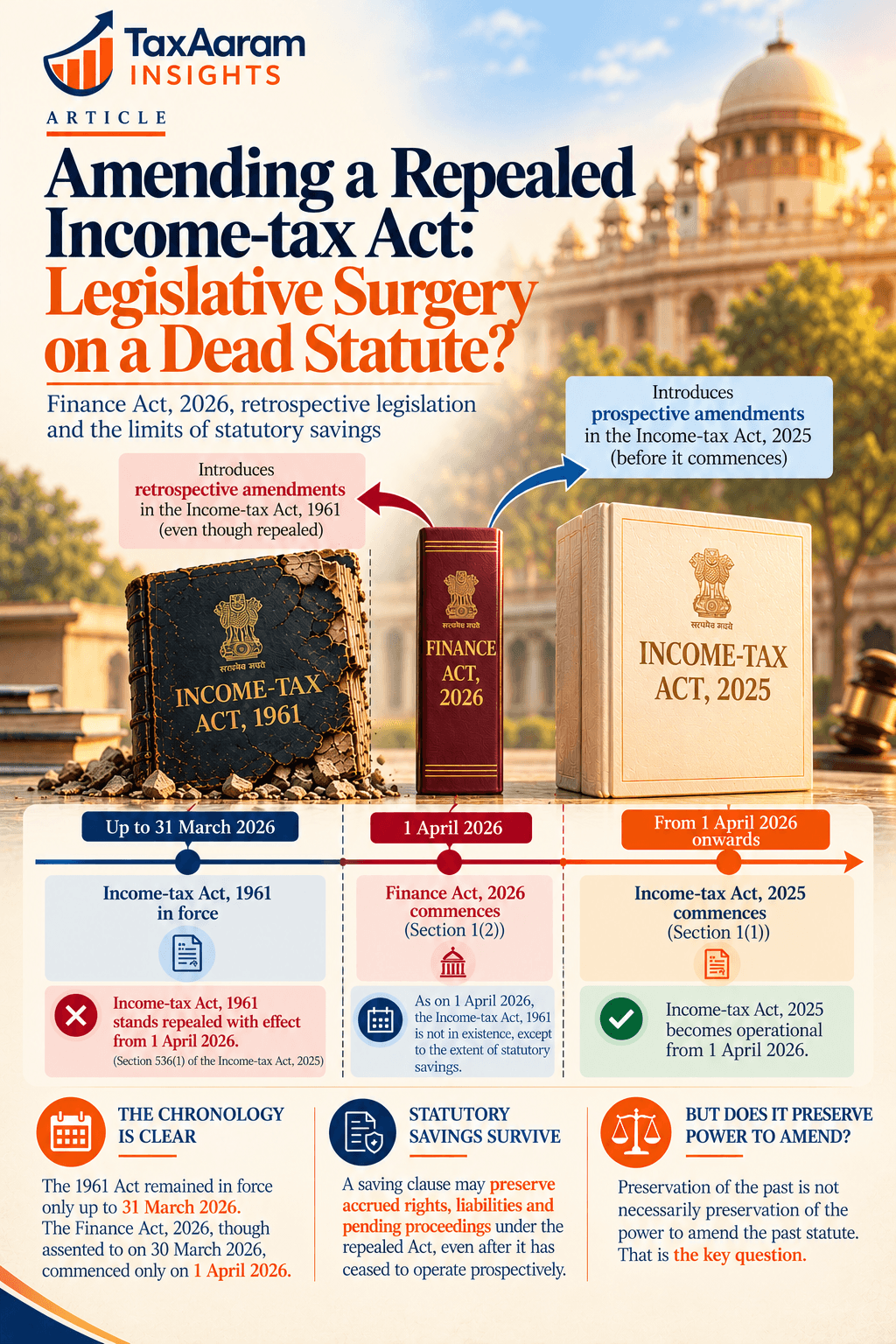
The Finance Act, 2026 will be historically remembered for two rather extraordinary legislative developments. First, it introduced amendments, several of them retrospective, into the Income-tax Act, 1961, even though that very enactment had ceased to operate with effect from 1 April 2026. Secondly, it amended the Income-tax Act, 2025, even before the new legislation commenced operation on that date. One statute was thus amended retrospectively as its legislative life came to an end, while the other was amended before taxpayers and tax administrators had begun operating under it.
Retrospective legislation is a recognised feature of fiscal law, but its validity may turn as much on the manner in which it is enacted as on the legal defect it seeks to remedy.
The debate surrounding the much-talked-about Jurisdictional Assessing Officer (JAO) versus Faceless Assessing Officer (FAO) controversy initially centred on the doctrine of substratum and the question whether retrospective legislation actually cured the legal defect identified by the courts. The controversy has, however, taken a more consequential turn. The question is no longer confined to whether Parliament has adequately cured the defect underlying the reassessment proceedings, but extends to a more anterior issue: could the retrospective amendments have been made in the first place by inserting provisions into an Act that stood repealed with effect from the very date on which the amending legislation came into force?
This shift in focus has implications extending well beyond Section 147A of the Income-tax Act, 1961, and the immediate dispute over reassessment jurisdiction. It brings into focus the principles governing the legal consequences of repeal, the limits of retrospective legislative power, and the distinction between preserving a repealed law for specified purposes and retaining the power to amend it.
Can Parliament, by an enactment commencing on 1 April 2026, insert a new provision into the Income-tax Act, 1961, which stood repealed with effect from the very same date, and simultaneously deem that provision to have existed from a retrospective date? Does the retrospective deeming fiction answer the anterior question of whether the provision could validly be inserted into the repealed enactment in the first place? Or does the doctrine of retrospective legislation permit the Legislature to reach back into the legal past, notwithstanding the fact that the statutory vehicle into which the amendment is sought to be inserted has ceased to operate prospectively?
These questions are no longer merely academic and have acquired immediate significance following the judgment of the hon’ble Andhra Pradesh High Court dated 12 October 2026 in ‘Bala Sreenivas Rao Somisetty v. Income Tax Officer’, W.P. No. 28520 of 2023 and batch.
The hon’ble Andhra Pradesh High Court has directly confronted these uncomfortable yet critical questions, while examining the constitutional validity of Section 147A of the Income-tax Act, 1961. The Court’s observations have implications extending beyond reassessment jurisdiction and warrant a wider examination of the retrospective amendments introduced by the Finance Act, 2026.
Andhra Pradesh High Court Ruling: a Repealed Statute cannot be amended merely by assigning an earlier date
The controversy before the hon’ble Andhra Pradesh High Court arose from Section 147A, inserted into the Income-tax Act, 1961, by the Finance Act, 2026, with retrospective effect from 1 April 2021. The provision declared that, for the purposes of Sections 148 and 148A, the expression “Assessing Officer” would mean an Assessing Officer other than the National Faceless Assessment Centre or an assessment unit referred to in Section 144B.
The immediate objective was to address the jurisdictional controversy concerning the authority of Jurisdictional Assessing Officers to initiate reassessment proceedings under Sections 148 and 148A, notwithstanding the faceless assessment framework and the scheme notified under Section 151A.
The Revenue maintained that the amendment was intended to provide certainty, clarify legislative intent and overcome conflicting judicial decisions. The assessees challenged the provision, inter alia, on the ground that it had been inserted into the Income-tax Act, 1961, after that Act had been repealed.
In paragraphs 103 to 107 of its judgment, the High Court examined the commencement of the Finance Act, 2026, alongside the repeal of the 1961 Act. It rejected the proposition that the date of Presidential assent or publication in the Gazette could automatically override an expressly stipulated commencement date. Applying Section 5 of the General Clauses Act, 1897, and the Supreme Court’s decision in ‘Common Cause v. Union of India’, (2003) 8 SCC 250, the Court held that where the legislation expressly specifies the date on which it comes into force, its operation must be determined accordingly.
The Court concluded in paragraph 106 that an amendment or insertion made into the repealed Act was legally unsustainable and lacked legal sanctity. Section 147A was consequently declared unconstitutional and struck down. The Court also held that the provision had not cured the underlying defect in the reassessment framework because the scheme under Section 151A remained unamended.
The judgment has opened a wider debate on the constitutional validity of retrospective amendments to a repealed statute. Its implications extend beyond the JAO-FAO controversy. The Finance Act, 2026 has also introduced retrospective changes to several other provisions of the Income-tax Act, 1961, dealing with limitation for completion of transfer pricing assessments, the Dispute Resolution Panel mechanism, Document Identification Number (DIN) mandate, approvals under section 151 and 153D and related procedural matters.
Section 1 of the Finance Act, 2026: A Commencement Clause with Considerable Significance
Before examining the validity of retrospective amendments to the repealed Income-tax Act, 1961, it would be useful to consider the commencement provision of the very legislation through which these amendments were introduced.
The chronology is central. The Finance Act, 2026, received Presidential assent on 30 March 2026. Section 1(2), however, provides, “Save as otherwise provided in this Act”, that Sections 2 to 129, clause (b) of Section 152 and Section 156 come into force on 1 April 2026. Sections 153 to 155 are to commence on a date appointed by the Central Government. Section 536(1) of the Income-tax Act, 2025, repealed the Income-tax Act, 1961, with effect from 1 April 2026.
The Finance Act, 2026, therefore came into force, in respect of the relevant provisions, on the same date on which the 1961 Act stood repealed. Yet several amendments purport to insert, substitute or omit provisions of the 1961 Act with effect from dates well before 1 April 2026, some reaching back to 2007.
The words “Save as otherwise provided in this Act” require careful consideration. The Legislature’s possible defence may be that the specific retrospective dates prescribed for individual amendments qualify the general commencement rule, and that the amendments must be given the retrospective operation Parliament expressly assigned to them.
But the distinction does not dispose of the entire controversy. Whether an amendment is intended to operate retrospectively is different from whether the repealed parent enactment remained capable of receiving that amendment. Section 1(2) prescribes commencement; it does not expressly state that the Income-tax Act, 1961, shall remain open to amendment after repeal, nor does it expressly override the repeal effected by Section 536(1) of the 2025 Act.
In simple words, the repeal effect is not displaced merely because the amendment declares that it shall be deemed to have been inserted from an earlier date. A deeming provision can prescribe the legal consequences that the legislature intends to attach to a past period. It cannot be assumed, without examining the source and scope of legislative power, that such a fiction also resolves the anterior question of whether the repealed enactment remains capable of amendment. The statutory form, the terms of the saving provisions and the nature of each amendment must therefore be examined separately.
Legislative Chronology
The chronology of the relevant legislative events admits of little ambiguity. The Income-tax Act, 1961, remained in force only up to 31 March 2026 and stood repealed with effect from 1 April 2026 under Section 536(1) of the Income-tax Act, 2025, subject to the savings expressly provided therein. The Finance Act, 2026, notwithstanding its Presidential assent on 30 March 2026, stipulated under Section 1(2) that the relevant provisions would come into force on 1 April 2026. It was, therefore, only on 1 April 2026 that the provisions introducing the impugned amendments became operative, by which date the 1961 Act had already ceased to exist as an operative enactment, save to the extent of its continued application under the statutory savings.
In these circumstances, the suggestion in certain quarters that, since the repeal of the 1961 Act and the commencement of the Finance Act, 2026, both took effect on the same date, it cannot be said that the amendments were introduced into a repealed enactment, does not withstand scrutiny. The coincidence of dates does not erase the legal consequence of repeal; it makes the chronology all the more significant. The relevant question is not whether both legislative events bear the date 1 April 2026, but whether the 1961 Act remained legally amenable to amendment when the amending provisions came into force.
The wider canvas of retrospective amendments
The retrospective amendments being made by the Finance Act 2026, in the Income Tax Act 1961, are not confined to Section 147A or reassessment jurisdiction. They touch transfer-pricing limitation, return filing, the Dispute Resolution Panel mechanism, assessment limitation, recovery, interest, refunds, penalty immunity, prosecution and the validity of assessments and electronic approvals. The following table summarises the relevant amendments to the 1961 Act and the effective dates specified in the Finance Act, 2026.
|
Finance Act, 2026 |
Provision of the Income-tax Act, 1961 affected |
Specified effective date |
|
Section 4 |
Section 92CA(3AA): computation of the 60-day period for passing a transfer-pricing order |
1 June 2007 |
|
Section 5 |
Section 139: return-filing due dates, revised returns and updated returns, including updated returns reducing losses and returns filed pursuant to Section 148 notices |
1 March 2026 |
|
Section 6 |
Section 140B(3A): additional income-tax on an updated return filed pursuant to a Section 148 notice |
1 March 2026 |
|
Section 7 |
Section 144B: electronic communication in place of affixing a digital signature in the specified provision |
1 April 2022 |
|
Section 8 |
Section 144C(4A) and (13A): time limits under the Dispute Resolution Panel mechanism |
1 April 2009 |
|
Section 8 |
Section 144C(4B) and (13B): corresponding time limits for search assessments under Section 153B |
1 October 2009 |
|
Section 9 |
Section 147A: definition of Assessing Officer for Sections 148 and 148A, notwithstanding judgments and Section 151A schemes |
1 April 2021 |
|
Section 10 |
Section 148: minimum 30-day period in the specified notice provision |
30 March 2026 |
|
Section 11 |
Section 150: reassessment pursuant to findings or directions in appellate, revisional or judicial orders |
1 February 2026 |
|
Section 12 |
Section 153(10): time for forwarding a draft assessment order under Section 144C |
1 April 2009 |
|
Section 13 |
Section 153B(1A): time for forwarding a draft assessment order in search cases |
1 October 2009 |
|
Section 14 |
Section 220(2): interest on specified penalty demands during appellate proceedings |
1 March 2026 |
|
Section 15 |
Section 222(1)(c): omission of a specified clause relating to recovery proceedings |
30 March 2026 |
|
Section 16 |
Section 234-I: fee for furnishing a revised return after nine months but before twelve months from the end of the relevant assessment year |
1 March 2026 |
|
Section 17 |
Section 245(1): set-off of refunds against amounts payable under the Income-tax Act, 2025 |
30 March 2026 |
|
Section 18 |
Section 245MA: waiver of penalty already imposed and penalty imposable |
1 March 2026 |
|
Section 19 |
Section 254(3A): electronic communication of specified ITAT orders |
30 March 2026 |
|
Section 20 |
Section 270A(11A): exclusion from the penalty base of specified income on which additional tax is paid under Section 140B(3A) |
1 March 2026 |
|
Section 21 |
Section 270AA: immunity from penalty and prosecution |
1 March 2026 |
|
Sections 22–31 |
Sections 274, 275A, 275B, 276, 276B, 276BB, 276C, 276CC, 276CCC, 276D, 277, 277A, 278, 278A and 280: penalty notices, offences and punishments |
1 March 2026 |
|
Section 32 |
Section 292BA: validity of assessments despite specified defects relating to a computer-generated Document Identification Number |
1 October 2019 |
|
Section 33 |
Section 292BC: validity of specified electronic approvals granted by income-tax authorities |
1 April 2021 |
|
Section 34 |
Second Schedule: specified omissions and substitutions relating to recovery and enforcement |
30 March 2026 |
The table illustrates the breadth of the legislative exercise and reveals that the amendments are not confined to Section 147A or to reassessment jurisdiction. They extend to transfer pricing limitation, the Dispute Resolution Panel mechanism, assessment limitation, returns, refunds, interest, penalty immunity, prosecution and the validity of assessments and approvals. Several of these provisions expressly employ language such as “notwithstanding anything contained in any judgment, order or decree of any court” or state that a provision shall “always be deemed” to have operated in the prescribed manner. The legislative exercise thus extends across multiple areas in which the legal position had become the subject of judicial scrutiny.
There is a further feature worth noting. The amendments to the 1961 Act were enacted within Sections 4 to 34 of the Finance Act, 2026, all falling within the range of Sections 2 to 129 governed by Section 1(2)(a). Parliament therefore used the very same enactment to prescribe a general commencement date of 1 April 2026 and to provide that individual amendments should be deemed to have operated from dates as far back as 1 June 2007. The resulting statutory structure makes it necessary to examine the relationship between the general commencement provision, the specific retrospective provisions and the repeal of the parent Act.
These amendments are not all identical in their purpose, effect or retrospective reach. Their validity must ultimately be examined provision by provision, including the precise commencement clause, the statutory power invoked, the nature of the amendment and the applicable savings provisions. Nevertheless, their common legislative form raises a question that cannot be confined to section 147A alone.
If the parent enactment had already been repealed, what was the legal source that enabled the legislature to amend it directly? Does section 536 of the Income-tax Act, 2025 preserve the 1961 Act only for the proceedings and purposes specified in it, or does it also permit Parliament to insert entirely new provisions into the repealed enactment after the date of repeal?
Existing Legal Jurisprudence: “Can a Repealed Act be Amended?”
The question whether a repealed enactment can subsequently be amended, substituted or supplemented by the insertion of new provisions must be examined against the settled principles governing the legal consequences of repeal.
The traditional formulation that a repealed Act cannot be amended is found in the general principles of statutory construction discussed in works such as Craies on Statute Law and Sutherland on Statutory Construction.
Craies on Statute Law, seventh edition, pages 411-412, reproduces the principle that when an Act is repealed, it is ordinarily to be considered, except as to transactions past and closed, as if it had never existed. The passage refers to Surtees v. Ellison and the formulation attributed to Tindal C.J., explaining that repeal ordinarily obliterates the statute from the statute book, subject to recognised exceptions for completed proceedings and transactions.
Sutherland on Statutory Construction, volume I, paragraph 1903, pages 328-329, states the corresponding principle in more direct terms: because an amending Act alters, modifies or adds to an earlier statute, courts ordinarily hold that a repealed Act cannot be amended merely by an attempt to amend it.
The related discussion in Sutherland, paragraph 2042, pages 522-523, concerns the consequences of repeal where neither a saving clause nor a general saving statute preserves the relevant legal operation.
The proposition is straightforward and elementary. The underlying logic is that an amending enactment ordinarily presupposes a parent enactment capable of receiving the amendment. If the parent statute has been repealed before the amending law commences, the question is not merely how far back the amendment is intended to operate. It is also what existing enactment the amending provision is legally capable of altering.
Federal Court Ruling in Jatindra Nath Gupta v. Province of Bihar, AIR 1949 FC 175
The hon’ble Federal Court in an authoritative pronouncement in the case of ‘Jatindranath Gupta vs. Province of Bihar’, AIR 1949 FC 175, recognised that a legislature with plenary power may revive or re-enact legislation that has expired and may legislate retrospectively. It nevertheless distinguished those powers from a later enactment that merely purports to amend an expired law on the assumption that the law remains alive. The Court reasoned that the intention to revive or re-enact could not be inferred simply from the form of an amendment. If the legislature intends to renew an expired enactment or enact a new law on the same terms with retrospective effect, that intention must be accomplished through the legislation actually enacted, rather than assumed from a purported amendment to a non-existent statute.
The majority bench of the Federal Court held that, “It is certainly competent to the Legislature in exercise of its plenary powers to revive or re-enact a legislation which has already expired by lapse of time. The Legislature is also competent to legislate with retrospective effect; but neither of these things seems to have been done in the present case. The Legislature proceeds on the footing that the old Act was alive at the date when the new Act was passed, the new Act merely purports to amend one of the provisions of the old Act. There could be no amendment of an enactment which is not in existence and from the fact that the Legislature purports to amend an Act, it could not be held as a matter of construction that the intention of the Legislature was to renew a dead Act or make a new enactment on the same terms as the old with retrospective effect.”
In re Kalyanam Veerabhadryya, AIR 1950 Mad. 243
The hon’ble Madras High Court applied the above principle in the context of the Madras Maintenance of Public Order Act, 1947, a temporary enactment whose operation was limited in duration. The question arose following an attempt, through the Madras Maintenance of Public Order Removal of Doubts Ordinance, 1949, to declare that the earlier Act remained in force and would continue to operate.
The Court held that an amending Act presupposes the existence of the original enactment. An amending Act is not an independent enactment in itself; it is intended to improve or more effectively carry out the purpose of an existing law. Similarly, a declaratory enactment intended to remove doubts must have an existing law whose meaning requires clarification. If a temporary Act has already ceased to operate, an amending or declaratory measure cannot be assumed to have any operation merely because it proceeds on the footing that the earlier Act remains alive.
Relying upon Jatindra Nath Gupta, the Madras High Court recognised that the legislature was competent to revive or re-enact the expired legislation and then amend it. The difficulty in the case before it was that the necessary revival or re-enactment had not been accomplished. The Court therefore declined to infer that result merely from the form of the subsequent legislative measure.
The principle and its limits
Read together, these authorities establish a crystal clear established legal jurisprudence. Repeal ordinarily extinguishes the future operation of an enactment, save for transactions, proceedings, rights and liabilities preserved by law. An amending enactment ordinarily presupposes an existing enactment capable of being amended. Where the earlier enactment has expired or been repealed, a subsequent legislature may, within its competence, revive or re-enact it, enact a fresh provision, or legislate expressly for matters preserved under an applicable savings clause. However, revival or re-enactment should not be inferred merely because a later law purports to amend the repealed enactment.
The rule is not an inflexible prohibition on all post-repeal legislative action and does not mean that repeal erases every consequence of the repealed law. The effect of repeal is subject to applicable saving provisions, and the law governing past transactions may continue to determine rights, liabilities and proceedings.
The hon’ble Supreme Court’s decisions in ‘State of Punjab v. Mohar Singh Pratap Singh’, AIR 1955 SC 84, and ‘T.S. Baliah v. T.S. Rangachari’, AIR 1969 SC 701, illustrate that repeal does not necessarily extinguish accrued liabilities or proceedings under the former law. But the preservation of the legal consequences of the past is conceptually distinct from the preservation of a general power to insert new provisions into the repealed statute.
The qualification matters. In ‘State of Rajasthan v. Mangilal Pindwal’, (1996) 5 SCC 60; AIR 1996 SC 2181, the hon’ble Supreme Court upheld retrospective amendment of an earlier version of Rule 244(2) of the Rajasthan Service Rules, although that version had been superseded. The parent body of service rules, however, continued to exist; the amendment concerned an earlier version of a rule within that continuing framework. The case also concerned retrospective rule-making under Article 309. It did not establish that a parent Act expressly repealed and replaced by a successor enactment may invariably be amended after repeal.
The material distinction is that the Rajasthan Service Rules, as the parent body of rules, continued to exist. It was the earlier version of the particular rule that had been superseded. The retrospective amendment operated upon the rule applicable during the period in which that version had been in force. The case concerned the exercise of rule-making power under Article 309 of the Constitution, which permitted retrospective operation in the circumstances before the Court.
The Supreme Court held that the Sutherland proposition concerning amendment of a repealed law did not apply to those facts. It did not hold that every repealed parent enactment remains open to amendment after repeal, irrespective of the statutory framework, the source of power or the terms of the repealing legislation.
The distinction is therefore fundamental. In Mangilal Pindwal, the parent service rules remained in existence, and the amendment concerned a former version of one rule within that continuing framework. In the present case, the Income-tax Act, 1961, itself was expressly repealed and replaced by the Income-tax Act, 2025, before the Finance Act, 2026, came into effect. The amendments are not merely substitutions within a continuing parent enactment; they are insertions into an Act that had already been repealed.
The source of power also differs. Mangilal Pindwal concerned retrospective rule-making under Article 309. The present controversy concerns an Act of Parliament and its exercise of legislative power under Articles 245 and 246, read with Entry 82 of List I. The reasoning in Mangilal Pindwal cannot be mechanically transplanted to a materially different statutory setting.
The decision must certainly be considered, but it does not displace the central question raised by the Finance Act, 2026: whether the retrospective amendment of a former version of a rule under a continuing parent framework is equivalent to inserting new provisions into an expressly repealed parent Act.
The position in Mangilal Pindwal would be analogous to permitting the Legislature to amend or insert a provision into the Income-tax Act, 1961, retrospectively, while that Act was still in force, even if the particular provision had not existed during the relevant earlier period. It does not follow, however, that the same power could be exercised through an amending enactment that came into force only when the parent Act had already been repealed. The distinction is between retrospectively changing the content of a provision within a subsisting legislative framework and purporting to amend an enactment that no longer exists as operative law.
Section 536 of the Income-tax Act, 2025: What exactly has been Saved?
The repeal of an enactment does not necessarily extinguish its entire legal operation. Savings provisions may preserve accrued rights, liabilities and proceedings under the former law, even after the enactment itself has ceased to operate prospectively.
However, preservation of the past is not necessarily preservation of the power to amend the past statute. A saving clause may keep a provision applicable to pending proceedings; it does not follow, without more, that the repealed enactment remains open to further legislative insertions after repeal.
The more difficult question, therefore, is whether the continued application of a repealed law for specified purposes also preserves the legislative power to amend that law after repeal. This distinction assumes particular significance under Section 536 of the Income-tax Act, 2025.
Section 536(2)(c) preserves the application of the Income-tax Act, 1961, to defined pending and subsequent proceedings relating to earlier tax years. Section 536(4) also provides, without prejudice to Section 536(2), for the application of Section 6 of the General Clauses Act, 1897.
The critical question is whether these provisions merely preserve the operation of the former law for the purposes specified, or whether they can also be construed as permitting further insertions, substitutions or omissions in the repealed enactment after 1 April 2026. The latter proposition does not follow automatically from the former; it requires an independent examination of the language and scope of the savings provisions.
A significant illustration of such an enquiry is the interplay of the retrospective insertion of section 147A in the Income Tax Act, 1961, with the Savings section 536(2)(u) in the Income Tax Act, 2025.
It provides for specified schemes made under the repealed Act to be treated as made under corresponding provisions of the Income-tax Act, 2025 or, where there is no corresponding provision, under Section 532, and to continue in force accordingly. The e-Assessment of Income Escaping Assessment Scheme, 2022, notified under Section 151A of the 1961 Act, is directly relevant to the JAO-FAO controversy. It prescribed automated allocation and a faceless process for reassessment and the issuance of notices under Section 148.
The scheme was not an incidental administrative arrangement. It was the statutory mechanism through which the legislative objective of efficiency, transparency, accountability and elimination of personal interface was implemented in reassessment proceedings. It was the foundational cornerstone of the judicial decisions holding that the relevant notices under Section 148 had to be issued through the prescribed faceless and automated allocation mechanism rather than through the ordinary, non-randomised action of the Jurisdictional Assessing Officer.
Section 147A, by contrast, sought retrospectively to define the Assessing Officer for the purposes of Sections 148 and 148A, notwithstanding judgments, Section 151A and schemes framed under it. The relationship between these provisions raises a question of statutory coherence. While Section 536 preserves the application of the former Act to specified proceedings and expressly provides for the continuation of relevant faceless schemes within the new statutory framework, Section 147A seeks to alter retrospectively the legal position governing reassessment under the repealed Act. The legal effect of these provisions must therefore be examined together, rather than treating the survival of the former law as conclusive of the validity of every subsequent amendment to it.
This creates a substantial tension in the Revenue’s position. On the one hand, the Revenue relies upon the savings provisions to argue that the old law continues to govern specified proceedings and that retrospective amendments to it can therefore be sustained. On the other hand, Section 536(2)(u) expressly carries forward the faceless scheme into the new legislative framework, while Section 147A purports to override the very scheme that had been preserved.
The contradiction is not merely technical. If Parliament considered the faceless scheme worthy of express preservation under the new Act, it becomes difficult to reconcile that statutory choice with a subsequent provision that seeks to neutralise the scheme’s jurisdictional consequences by retrospectively inserting a provision into the repealed Act. The Revenue cannot treat the savings provisions as preserving the old statutory framework whenever that supports its argument, while overlooking the specific scheme that Parliament itself has expressly carried forward.
Therefore, Section 536(2)(u) does not, by itself, determine the validity of Section 147A. It does, however, lend significance to the distinction between preserving a statutory scheme under the successor legislation and preserving a general power to amend the repealed enactment. Ultimately, the question is whether the savings provisions, properly construed, extend beyond the continued application of the former law to specified matters and authorise the direct insertion of new provisions into the repealed Act. That is a question of statutory construction which cannot be answered merely by pointing to the survival of proceedings under the former law.
Existing Jurisprudence: Savings Clause does not confer an Unlimited Power to Amend
The distinction between preserving a repealed enactment for specified purposes and retaining legislative power to amend it has also arisen in the transition from the State VAT regimes to GST. Three decisions of the Kerala and Telangana High Courts provide a useful comparative perspective. Although they arose in a different constitutional and fiscal setting, their reasoning is relevant to the broader question whether a savings provision, by preserving the operation of an erstwhile statute, also preserves an unrestricted power to amend it.
In Re Reliance Industries v. State of Gujarat, AIRONLINE 2020 GUJ 421: the legal consequences of repeal cannot be bypassed
The hon’ble Gujarat High Court’s decision in Reliance Industries Ltd. v. State of Gujarat, decided on 16 April 2020, provides substantial support for this proposition. The case concerned Section 84A of the Gujarat Value Added Tax Act, 2003, inserted retrospectively to exclude specified periods from the computation of limitation for assessment and revision proceedings.
The challenge arose after the constitutional changes introduced by the Constitution (101 Amendment) Act, 2016, altered the legislative distribution of power concerning indirect taxation. The High Court held that the State Legislature lacked the requisite legislative competence to introduce Section 84A in the circumstances before it. It also held that the provision was manifestly arbitrary and unreasonable and did not constitute a valid validating Act.
Of particular relevance is the Court’s analysis of the relationship between repeal, savings and legislative power. It distinguished the power to preserve past rights, liabilities and proceedings from the power to enact further amendments to the repealed legislation. The savings provisions could preserve proceedings under the former law, but could not independently supply the legislative competence necessary to enact a new amendment after the relevant power had been withdrawn.
The judgment also examined the traditional doctrine that repeal, subject to recognised exceptions, obliterates the repealed enactment, while preserving transactions and proceedings protected by law. It rejected the proposition that a saving provision for pending proceedings could automatically be treated as authority for further legislative action in relation to the repealed statute.
In Re ‘Baiju A.A. v. State Tax Officer’
Kerala High Court, W.P.(C) No. 9963 of 2019, decided on 6 December 2019; AIRONLINE 2019 KER 825; (2020) 1 KLT 233.
The hon’ble Kerala High Court examined the validity of a subsequent amendment to Section 25 of the Kerala Value Added Tax Act, 2003, introduced through the Kerala Finance Act, 2018, after the KVAT Act had been repealed in the transition to GST. The amendment sought to extend the period for reopening past assessments. The Court distinguished this post-repeal amendment from an earlier amendment made through the Kerala Finance Act, 2017, while the former statutory framework was still operative. It held that the saving of rights, liabilities and proceedings under the repealed enactment did not, in the circumstances before it, preserve the State Legislature’s power to enact further amendments to that enactment after the relevant legislative competence had been withdrawn.
In Re ‘State Tax Officer v. Baiju A.A.’
Kerala High Court, W.A. No. 48 of 2020 and connected appeals, decided on 22 August 2022.
The Division Bench affirmed the decision in Baiju A.A. and dismissed the State’s challenge. The judgment reinforces the distinction between saving the operation of an erstwhile enactment for specified purposes and retaining legislative authority to amend it after repeal. The saving provisions could preserve the legal consequences of the former VAT regime, but could not independently restore legislative competence that had been withdrawn by the constitutional transition to GST. The decision thus lends appellate support to the proposition that the continued operation of a repealed statute for limited purposes does not, without more, make it amenable to further legislative amendment.
In Re SNJ Synthetics Limited v. Joint Commissioner (ST) and Others
Telangana High Court, in W.P. Nos. 7893, 9550 and batch of 2021, decided on 5 July 2022.
The hon’ble Telangana High Court considered the validity of retrospective amendments to the former Telangana VAT framework following the constitutional transition to GST. It examined the State’s legislative competence in light of the amended distribution of legislative powers, the saving provisions under the Telangana GST legislation and the constitutional provisions governing the transition. Relying on the reasoning in Baiju A.A., the Court held that the saving of rights, liabilities and actions under the former VAT legislation did not authorise further legislative action in relation to the repealed enactment where the State no longer possessed the requisite legislative competence. The decision is particularly relevant for its analysis of the distinction between a saving provision and the independent constitutional source of power necessary to amend a statute.
These decisions reinforce the distinction between continuing to administer a repealed law for saved purposes and legislating afresh in relation to that law after the relevant legislative authority has been withdrawn. Their common principle is that the saving of past rights, liabilities and proceedings does not, without more, preserve a general power to amend the repealed enactment.
The Historical Lesson from the Transition between the 1922 and 1961 Acts
The transition from the Indian Income-tax Act, 1922 to the Income-tax Act, 1961 offers a useful historical comparison.
The Finance Bill, 1961, was introduced before the Income-tax Act, 1961 Act came into force, and proposed amendments to the Income-tax Act, 1922 Act, at a time when that Act was still in force. The Income-tax Act, 1961 came into operation on 1 April 1962 and repealed the 1922 Act under section 297(1), subject to the savings in section 297(2).
The Finance (No. 2) Act, 1962 operated within the framework of the new Income-tax Act, 1961 and didn’t introduce any retrospective amendment in the repealed Income-tax Act, 1922.
If this legislative chronology is juxtaposed with the present situation, a significant realisation emerges. If the intention was to introduce retrospective amendments into the Income-tax Act, 1961, the natural legislative occasion to do so would have been the Finance Act, 2025, when the 1961 Act was still in force and before its repeal took effect on 1 April 2026. Instead, the amendments were enacted through the Finance Act, 2026, which came into force on the very date on which the Income-tax Act, 2025, became operative and the 1961 Act stood repealed.
The sequence perhaps brings to mind a traveller who misses the scheduled flight, boards a bus in an attempt to make up for lost time, but reaches the destination only to discover that the window of opportunity has already closed. In legislative terms, the question is whether a retrospective amendment can make up for the fact that the enactment sought to be amended had already ceased to exist when the amending legislation came into force.
The very circumstance that these amendments were considered necessary to be introduced retrospectively into the repealed Income-tax Act, 1961, lends further weight to the inference that the legislative exercise was directed, at least in substantial measure, towards neutralising the adverse judicial pronouncements that had exposed several critical jurisdictional infirmities in the respective contentious issues.
A more relevant illustration is the Finance Act, 1963, which retrospectively amended section 297(2)(e) of the 1961 Act with effect from 1 April 1962. The amendment concerned the statutory savings framework governing the continued operation of section 23A of the 1922 Act and related matters. In other words, Parliament amended the savings provision in the successor Act, rather than simply treating the repealed 1922 Act as though it remained generally available for direct amendment.
This historical example is not conclusive proof that Parliament must always legislate through a savings provision. Nor does it establish that every later legislative technique is invalid. It does, however, demonstrate that the successor Act's repeal and savings architecture provides a direct and intelligible legislative route for defining, modifying or clarifying the extent to which provisions of the old law continue to operate.
The example is especially pertinent to the present debate. If Parliament wishes to change the consequences of the repeal of the 1961 Act, or to clarify how the old Act is to apply to proceedings preserved under section 536, an amendment to section 536 itself would have been a more transparent and structurally coherent route than inserting fresh provisions directly into the repealed Act.
Concluding Reflections
The immediate controversy concerning section 147A may therefore prove to be only the beginning. The courts will need to determine whether section 536 of the Income-tax Act, 2025, read with section 6 of the General Clauses Act, preserves the 1961 Act only for the specified proceedings and purposes, or whether it also supports the direct insertion and substitution of provisions in that repealed enactment. They will also need to examine each amendment in its own statutory context, including its retrospective operation and the legal defect it purports to cure.
The traditional authorities in Craies and Sutherland, the Federal Court’s decision in Jatindra Nath Gupta, and the Madras High Court’s decision in Kalyanam Veerabhadryya all point to a basic proposition that an amending enactment ordinarily presupposes an existing enactment to which it can attach. Revival or re-enactment should not be inferred merely from a later law’s attempt to amend an expired statute.
The question is ultimately one of legislative form, statutory construction and constitutional discipline. Retrospective legislation is a recognised instrument of Parliament. But retrospective effect cannot, by itself, resolve every question about the legal existence of the enactment being amended.
If the legislative objective was to alter the law applicable to proceedings preserved after 1 April 2026, an express amendment to section 536, or a fresh enactment accompanied by carefully drafted transitional provisions, would have been a clearer and more defensible course. It would have placed the legislative intervention within the living framework of the Income-tax Act, 2025, rather than inviting a dispute over the continued existence of the 1961 Act.
In the final analysis, the metaphor of surgery on a dead body is only a starting point. The legal answer lies in the statutory text. A repealed statute may survive for saved purposes, but the extent of that survival must be found in the law that preserves it. Where Parliament intends to change the consequences of repeal, the more certain course is to amend the savings provision or enact the necessary rule afresh, rather than leave the courts to determine whether a repealed statute could still receive new life through a direct amendment.
[This Article has been authored by our Founder, Shri Mayank Mohanka, FCA, and has also been published in Taxsutra.]