

.jpg)
The hon’ble Supreme Court’s recent nine-Judges’ Bench decision in ‘State of Uttar Pradesh v. Jai Bir Singh’, [LSI-1290-SC-2026-(NDEL)]/ 2026 INSC 897, pronounced on 20.8.2026, has brought a long-running chapter in Indian labour jurisprudence into sharper focus.
The judgment revisits the celebrated seven-Judges’ Bench ruling in ‘Bangalore Water Supply and Sewerage Board v. A. Rajappa’ (1978) 2 SCC 213, particularly the meaning of “industry” under section 2(j) of the Industrial Disputes Act, 1947 and the continued relevance of the broader “triple test” laid down therein.
The controversy before the nine-Judge Bench arose from decades of uncertainty surrounding section 2(j) of the Industrial Disputes Act, 1947. The provision defined “industry” in extremely wide terms, covering almost the entire gamut of business, trade, undertaking, manufacture or calling of employers and various forms of employment, handicrafts, calling or avocation of workmen, whether commercial/profit oriented or not.
The watershed came with the ‘Bangalore Water Supply’ judgement, where the majority formulated the celebrated “Triple Test”. An activity would ordinarily constitute an industry where there was:
-
systematic and organised activity;
-
cooperation between employer and employee; and
-
production or distribution of goods or services directed towards satisfaction of human wants and wishes.
Importantly, profit motive and commercial nature was not regarded as an essential ingredient.
The breadth of the formulation subsequently generated substantial litigation concerning hospitals, educational institutions, charitable organisations, clubs, professions and governmental activities and sovereign functions. Parliament attempted to recalibrate the definition through the Industrial Disputes (Amendment) Act, 1982. The amended definition sought to introduce several exclusions, including hospitals, educational and research institutions, charitable, social, religious and philanthropic institutions and certain sovereign functions and domestic services. But the amended definition was never brought into force.
The Industrial Relations Code, 2020 eventually changed the statutory landscape and explicitly excludes all such entities from the purview of the term ‘industry’ in section 2(p) of the said enactment. The Code became operational from 21 November 2025. The Apex Court judgment records that the Industrial Disputes Act was formally repealed subsequently on 2 February 2026. Thus, while 21 November 2025 is the critical transition date for the operation of the new Code, the formal repeal occurred later.
The nine-Judge Bench has now settled the position for pending disputes. The wafer-thin majority conclusion is that the interpretation in Bangalore Water Supply does not require reconsideration and that pending references under the Industrial Disputes Act are to be decided according to the law governing “industry” before the operationalisation of the 2020 Code.
The judgment therefore creates a clear statutory firewall. Old disputes under the old Act remain governed by section 2(j) of the repealed Industrial Disputes Act, 1947, as judicially interpreted by the Apex Court in the Bangalore Water Supply judgement, on the basis of the ‘triple test’. Future disputes under the Industrial Relations Code must be decided under section 2(p) of the new Industrial Relations Code 2020, on its own text, scheme and object.
The Court was particularly emphatic on the second limb. The Industrial Relations Code, 2020 is an independent enactment and the Bangalore Water Supply judgment is not to become the interpretative “sheet anchor” for the new Code.
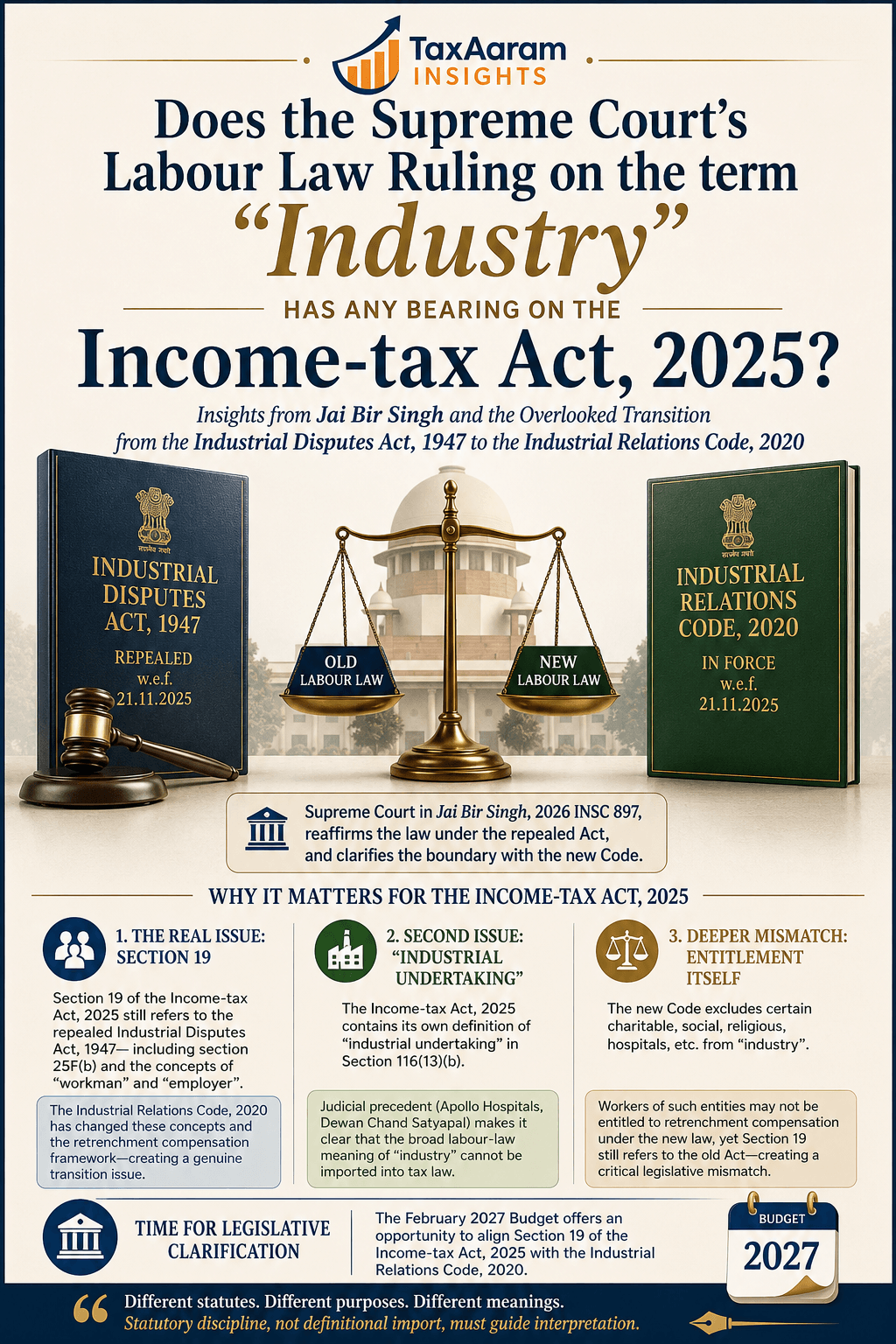
Does the Supreme Court’s Labour Law Ruling have any Bearing on the Income-tax Act, 2025?
No doubt the said Apex Court judgement is purely confined to labour law jurisprudence. However, what makes the judgment particularly interesting for tax practitioners is that its seemingly confined labour-law implications may have some unassuming but tangible consequences for the interpretation and operation of certain provisions of the Income-tax Act, 2025, as well.
At first sight, the correctness or otherwise of the broader ‘Bangalore Water Supply’ test may appear to have little direct bearing on the Income-tax Act, 2025. However, the real significance of the judgment for tax law lies elsewhere. In the course of resolving the labour-law controversy, the judgment brings into sharp focus a fundamental statutory development that appears to have been overlooked in the transition to the new Income-tax Act, 2025: the Industrial Disputes Act, 1947 stood repealed with effect from 21 November 2025 and was succeeded by the Industrial Relations Code, 2020.
That development assumes significance because the newly enacted Income-tax Act, 2025, while substantially redrafting and modernising the income-tax statute, continues to contain an express reference to the now-repealed Industrial Disputes Act, 1947 in its provisions relating to workmen’s retrenchment compensation. The issue appears to have escaped attention not only in the drafting and legislative process of the Income-tax Act, 2025, but also among taxpayers, tax professionals and, so far, the Income-tax Department. Significantly, even the Parliamentary Select Committee examining the Income-tax Bill, 2025 appears not to have flagged this redundant statutory reference.
The question, therefore, is not whether the Supreme Court’s interpretation of the term “industry” under the Industrial Disputes Act, can be imported wholesale into income-tax law. It cannot. The more precise and relevant question is whether the repeal of the Industrial Disputes Act, 1947, its succession by the Industrial Relations Code, 2020, and the statutory changes brought about by that transition have any consequences for the provisions of the Income-tax Act, 2025 which continue to refer to the old labour legislation.
The answer is yes, but in a specific and significant statutory context, principally section 19 of the Income-tax Act, 2025.
The direct Income-tax connection: Section 19 of the Income-tax Act, 2025
Section 19 of the Income-tax Act, 2025 provides for deductions from income chargeable under the head “Salaries”.
Serial No. 10 of the Table contained in Section 19(1) of the Income-tax Act, 2025, deals with allowable deductions in respect of compensation received by a workman at the time of his retrenchment. The provision recognises compensation received under the Industrial Disputes Act, 1947, under any other Act, rules, orders or notifications, standing orders, awards, contracts of service or otherwise. The deduction is restricted to the minimum of:
-
the compensation actually received;
-
the amount calculated under section 25F(b) of the Industrial Disputes Act, 1947; and
-
such amount, not being less than ₹50,000, as may be notified by the Central Government.
The provision goes further. Section 19(2)(d) of the Income-tax Act, 2025 expressly provides that, for the entries relating to retrenchment compensation, the expressions “employer” and “workman” shall have the same meanings as assigned to them in the Industrial Disputes Act, 1947.
This is where the repeal of the 1947 Act becomes a live issue for the Income-tax Act, 2025. The problem is not merely that Parliament has retained an obsolete statutory citation. The successor Industrial Relations Code has changed the architecture of these concepts.
A fundamental disconnect: Tax deduction without the underlying Labour-law entitlement
A critical and perhaps the most fundamental interpretational issue arises from the scope of the underlying entitlement itself. Under section 25F(b) of the Industrial Disputes Act, 1947, the retrenchment compensation framework applied to a “workman” employed in an “industry”, with the expression “industry” carrying the expansive meaning recognised in Bangalore Water Supply. Consequently, workmen of hospitals, charitable, social and philanthropic institutions and other establishments falling within that broad definition could, subject to fulfilment of the statutory conditions, be entitled to retrenchment compensation and correspondingly claim the deduction/exemption available under section 10(10B) of the Income-tax Act, 1961.
The Industrial Relations Code, 2020, however, has consciously narrowed the statutory framework by expressly excluding specified charitable, social and philanthropic activities, as well as certain sovereign functions, from the definition of “industry”. The consequence is potentially significant: where the underlying activity itself falls outside the new definition of “industry”, the statutory right to retrenchment compensation under the Code would ordinarily not arise, and consequently there should ordinarily be no occasion for a corresponding deduction under section 19 of the Income-tax Act, 2025.
Yet section 19 continues to refer to the repealed Industrial Disputes Act and its section 25F(b), without incorporating the exclusions introduced by the successor Code. This creates a striking legislative mismatch: the new principal labour legislation may deny the underlying retrenchment entitlement in respect of specified excluded establishments, while the new Income-tax Act continues to frame the tax deduction by reference to the repealed regime under which such establishments could still fall within the ambit of “industry”. This is not merely an obsolete cross-reference; it potentially affects the very class of recipients entitled to claim the deduction and warrants explicit legislative clarification.
“Workman” has become “worker”, while “employee” is now a separate and wider class
Under section 2(s) of the Industrial Disputes Act, “workman” broadly covered persons employed to perform manual, unskilled, skilled, technical, operational, clerical or supervisory work for hire or reward, subject to exclusions for persons employed mainly in managerial or administrative capacities and specified supervisory personnel.
The Industrial Relations Code, 2020 reorganises this structure. Section 2(l) defines “employee” in broad terms. It covers a person employed in an industrial establishment to perform skilled, semi-skilled or unskilled, manual, operational, supervisory, managerial, administrative, technical or clerical work for hire or reward.
Section 2(zr) separately defines “worker”. It broadly carries forward the traditional workman categories, including manual, unskilled, skilled, technical, operational, clerical and supervisory work. It also specifically includes working journalists and sales promotion employees. At the same time, it excludes persons employed mainly in managerial or administrative capacities and supervisory employees drawing wages above ₹18,000 per month, or such higher amount as may be notified.
The distinction is important. Every worker is an employee, but every employee is not a worker. That distinction becomes decisive in the context of retrenchment compensation.
Retrenchment compensation belongs to the “worker”, not the wider “employee”. Section 70 of the Industrial Relations Code is expressly titled “Conditions precedent to retrenchment of workers”. It provides that no worker who has completed at least one year of continuous service can be retrenched unless the prescribed notice and compensation requirements are satisfied.
The provision therefore attaches the statutory retrenchment compensation right to the worker. The wider definition of “employee” in section 2(l) does not automatically confer the section 70 retrenchment entitlement on every employee. A managerial or administrative employee may be an “employee” but may not be a “worker”.
This has an immediate implication for section 19 of the Income-tax Act, 2025. The tax statute continues to use “workman”, not “employee”, for retrenchment compensation. Therefore, if Parliament were to update section 19, it would be conceptually inappropriate simply to replace “workman” with the wider expression “employee”. The corresponding statutory category under the new labour regime is much more naturally “worker” under section 2(zr) of the Industrial Relations Code, 2020.
This is a substantive distinction, not merely a change in terminology.
“Employer” has also been materially expanded
The transition is equally significant for the term “employer”. Section 2(g) of the Industrial Disputes Act, 1947, contained a relatively structured definition centred upon the person or authority responsible for the industry, including specified governmental authorities and local authorities.
Section 2(m) of the Industrial Relations Code, 2020 is considerably more comprehensive. It covers a person who employs one or more employees or workers, directly or through another person, and specifically includes the occupier of a factory, a named factory manager, the person or authority having ultimate control over an establishment, a manager or managing director entrusted with its affairs, a contractor and the legal representative of a deceased employer.
Thus, section 19(2)(d) of the Income-tax Act, 2025 is still referring to outdated and obsolete terminology or references in the repealed labour legislation, whose statutory boundaries have materially changed in the new labour law.
The computation methodology of retrenchment compensation has also changed, potentially affecting the tax deduction
There is a further and potentially more consequential issue. Section 25F(b) of the Industrial Disputes Act, 1947 prescribed retrenchment compensation at the rate of fifteen days' average pay for every completed year of continuous service, or any part thereof in excess of six months.
Section 70(b) of the Industrial Relations Code, 2020 substantially retains this formula. However, it introduces an additional element. The compensation is to be equivalent to fifteen days' average pay, or average pay of such days as may be notified by the appropriate Government, for every completed year of continuous service or part thereof in excess of six months.
But section 19(1), Serial No. 10 of the table of the Income-tax Act, 2025 presently does not refer to section 70(b) of the Industrial Relations Code, 2020. It continues expressly to cap one limb of the deduction by reference to the amount calculated under section 25F(b) of the repealed Industrial Disputes Act, 1947.
This could create an anomalous result. Suppose, illustratively, that the appropriate Government exercises the power under section 70(b) of the Industrial Relations Code, 2020 and increases the statutory retrenchment entitlement from fifteen days' average pay to, say, twenty days' average pay for every completed year of service. The worker's legally mandated compensation under the Industrial Relations Code would then increase.
For example, assuming the notified monetary ceiling continues to be ₹5 lakh and all other conditions are satisfied, a worker might receive ₹4.80 lakh as statutory retrenchment compensation calculated under an enhanced section 70(b) formula, while the corresponding section 25F(b) computation under the old Act works out to only ₹3.60 lakh. On a literal reading of section 19, the deduction could arguably remain restricted to ₹3.60 lakh because the tax provision expressly adopts the old section 25F(b) computation.
That would produce the peculiar situation where the labour-law entitlement has migrated to the new Code but the tax deduction remains computationally anchored to the repealed Act.
Section 8 of the General Clauses Act: useful bridge, but not a complete answer
A reference in section 19 of the Income-tax Act, 2025 to the Industrial Disputes Act, 1947 is not confined to a provision which has merely been renumbered. The tax provision refers to the concepts of “employer”, “workman” and even computation methodology of the repealed Act, whereas the successor legislation has introduced the terminology of “employer”, “employee” and “worker”, with materially revised definitions, and has also inserted an additional variable in the computation methodology.
This is where section 8 of the General Clauses Act, 1897 assumes importance. The said section provides a well-established transitional mechanism where an enactment is repealed and re-enacted. References to the repealed provision are generally construed as references to the re-enacted provision, unless a different intention appears.
This provision can potentially keep section 19 of the Income-tax Act, 2025 operational by treating the references to the now repealed Industrial Disputes Act, 1947, as references to the now applicable Industrial Relations Code, 2020, for instance, reference to section 25F(b) of the Industrial Disputes Act, 1947 as a reference to the corresponding retrenchment compensation provision under Section 70(b) of the Industrial Relations Code, 2020.
There is, however, a qualification. The corresponding new definitions of the terms ‘worker’, ‘employer’ and the computation methodology as prescribed in Section 70(b) of the new Industrial Relations Code, 2020, are not the exact reproductions of the erstwhile terms and section 25F(b) of the repealed Industrial Disputes Act, 1947. Section 70(b) of the new legislation retains the fifteen-day formula but also permits the appropriate Government to notify another number of days, and also expands the scope of the terms ‘worker’ and ‘employer’.
The question therefore arises whether such repealed references of the old labour law legislation in Section 19 of the Income-tax Act, 2025, in the context of retrenchment compensation, can simply be read as references to the materially altered corresponding new sections of the new labour legislation, relying upon the general proposition contained in section 8 of the General Clauses Act, simplicitor.
There is a reasonable case for a harmonious interpretation. But it is not free from doubt. More importantly, taxpayers should not have to litigate the issue.
The clean solution is legislative amendment. Three corrections are therefore desirable in section 19 of the Income-tax Act, 2025.
The transition from the Industrial Disputes Act to the Industrial Relations Code presents at least three distinct drafting issues in section 19.
First, the class of persons. “Workman” under the repealed Act should be appropriately aligned with “worker” under section 2(zr) of the new Code, rather than with the wider class of “employee”.
Second, the employer definition. The reference to “employer” should be aligned with section 2(m) of the Industrial Relations Code.
Third, the computation. The reference to section 25F(b) of the repealed Industrial Disputes Act, 1947 should be replaced by an appropriate reference to section 70(b) of the Industrial Relations Code, 2020, with Parliament expressly clarifying whether any notification altering the number of days under section 70(b) is intended to affect the tax deduction.
The February 2027 Budget would therefore be an appropriate opportunity for legislative housekeeping in section 19 of the Income-tax Act, 2025, through an appropriate amendment being brought about by the Finance Act 2027.
Does “Industry” in labour law determine “Industrial undertaking” in tax law?
The second interpretational issue, though narrower in scope, concerns the expression “industrial undertaking” and whether the broad labour-law jurisprudence on “industry” can have any bearing on its meaning under the Income-tax Act, 2025.
The Income-tax Act, 2025 uses the expression “industrial undertaking” in several provisions. It would be tempting to argue that the Supreme Court's exhaustive examination of “industry” under the Industrial Disputes Act must now influence the meaning of “industrial undertaking” under the Income-tax Act.
That would be an incorrect approach, nonetheless. The two expressions operate in different statutory contexts and serve different legislative purposes.
The clearest example is section 116 of the Income-tax Act, 2025, (corresponding to section 72A of the Income-tax Act, 1961) dealing with treatment of accumulated losses and unabsorbed depreciation in specified amalgamations and reorganisations. Section 116(1) refers to an amalgamation involving a company owning an “industrial undertaking”. But section 116(13)(b) then expressly defines “industrial undertaking” for the purposes of that section. The definition covers undertakings engaged in manufacture or processing of goods, manufacture of computer software, generation or distribution of electricity or other power, telecommunication services, mining, and construction of ships, aircraft or rail systems.
There is therefore no statutory vacuum to be filled by borrowing the meaning of “industry” from labour law. This principle has already been applied by the courts. In ‘ACIT v. Apollo Hospitals Enterprises Ltd.’ in Writ Appeal No. 1041 of 2006, the Madras High Court considered whether hospitals could qualify as an “industrial undertaking” for purposes of the tax provisions relating to amalgamation. The argument sought to rely upon the broad labour-law concept of “industry”, including the jurisprudence under the Industrial Disputes Act.
The Court rejected that approach. Where the Income-tax Act itself specifies what constitutes an industrial undertaking, there is no warrant to import a definition from another statute merely because the expression is similar. The Court also examined the specific activities recognised by the tax statute and concluded that a hospital could not be brought within the tax concept merely because a hospital might constitute an “industry” under labour legislation.
Sections 138 and 141 of the Income-tax Act, 2025: A similar story
Sections 138 and 141 of the Income-tax Act, 2025, corresponding broadly to sections 80-IA and 80-IB of the Income-tax Act, 1961, also employ the expression “industrial undertaking”.
But these provisions require a slightly more nuanced analysis.
Section 138 expressly provides deductions by reference to the corresponding provisions of section 80-IA of the 1961 Act, as if that Act had not been repealed. Section 141 adopts a similar transitional mechanism by referring to section 80-IB of the 1961 Act and preserving its eligibility conditions for the relevant tax years.
The expression “industrial undertaking” under section 80-IA was itself linked to a specific tax-law definition, namely the Explanation to section 33B. Section 80-IB, on the other hand, contains its own statutory conditions governing what qualifies as an eligible industrial undertaking, including manufacturing, employment and other prescribed requirements.
Thus, even here, the interpretative route does not run through section 2(j) of the Industrial Disputes Act.
The same conceptual distinction emerged in ‘CIT v. M/s Dewan Chand Satyapal’ [2013] 353 ITR 618 (Delhi), concerning a diagnostic centre providing X-ray, MRI and CT Scan services. The Delhi High Court considered whether the diagnostic centre was an “industrial undertaking” for purposes of section 80-IA. The sophisticated nature of the equipment and technology did not, by itself, convert a service provider into an industrial undertaking for the purposes of the fiscal incentive.
These cases establish an important jurisprudential boundary. “Industry” under labour law is not the statutory definition of “industrial undertaking” under the Income Tax Act.
The Supreme Court's judgment therefore does not enlarge, restrict or redefine “industrial undertaking” for purposes of sections 116, 138 or 141 of the Income-tax Act, 2025.
The Bottomline
The Supreme Court's Nine-Judge judgment in ‘State of Uttar Pradesh v. Jai Bir Singh’ confirms that the ‘Bangalore Water Supply’ interpretation survives for pending disputes governed by the repealed Industrial Disputes Act. Secondly, the Industrial Relations Code, 2020 must be interpreted independently and cannot be coloured by the old jurisprudence.
The said judgement does have a bearing on the Income-tax Act, 2025, but not because the tax statute must now adopt the Triple Test for determining “industry” or “industrial undertaking”.
Its real significance is narrower and more practical. For income-tax purposes, section 19 of the Income-tax Act, 2025 is the statutory provision requiring immediate legislative attention, because it continues to expressly refer to the redundant section 25F(b) and the terms “employer” and “workman” of the repealed Industrial Disputes Act, 1947.
Until the statutory correction is made, section 8 of the General Clauses Act, offers a strong transitional interpretative basis for reading references to the repealed provisions with reference to their corresponding re-enacted provisions, subject to the statutory qualification that no contrary intention appears.
Finally, the judgment can’t be construed to spill over into provisions such as sections 116, 138 and 141 of the Income-tax Act, 2025, merely because those provisions use the expression “industrial undertaking”.
“Industry” under labour law and “industrial undertaking” under tax law may sound closely related, but their meaning must ultimately be determined by the statute in which they live, the object which that statute seeks to achieve, and the precise manner in which Parliament has drafted the provision.
Section 116 contains its own definition, while sections 138 and 141 preserve the corresponding 1961 Act provisions through express transitional cross-references. Their interpretation must therefore remain anchored in the Income-tax legislation and the specific statutory context in which “industrial undertaking” is employed.
[This Article authored by our Founder- Shri Mayank Mohanka, FCA, has also been published in Taxsutra.]