

.jpg)
Foreign assets often have a long memory. A bank account opened while working overseas, shares accumulated abroad, an inherited property or an investment made years ago may continue to have tax-compliance implications long after the circumstances in which it arose have disappeared. A disclosure lapse that may seem minor today can, under the Black Money law, carry significant tax and legal consequences years later.
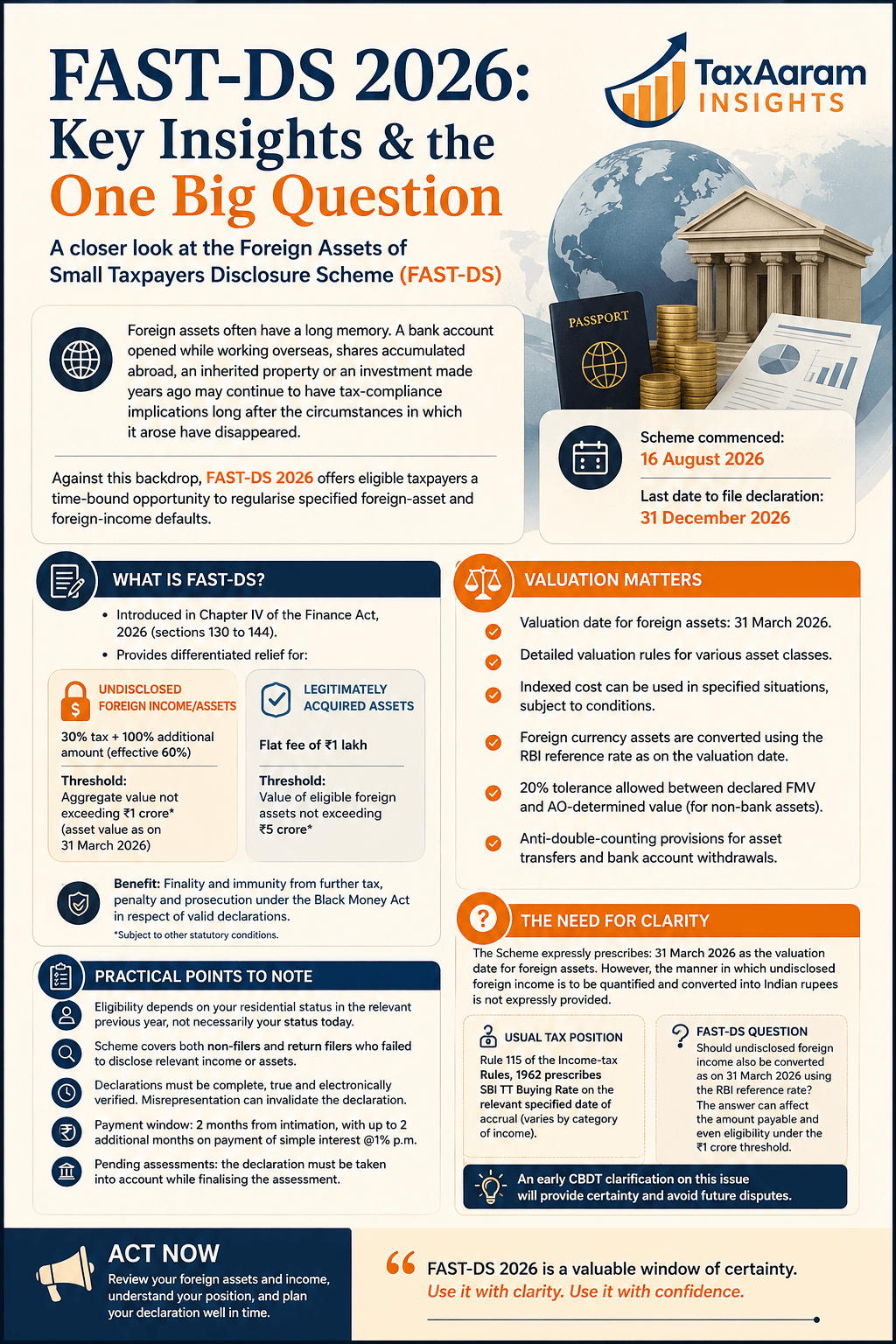
Against this backdrop, the Foreign Assets of Small Taxpayers Disclosure Scheme, 2026 (FAST-DS) offers eligible taxpayers a time-bound opportunity to regularise specified foreign-asset and foreign-income defaults. Introduced under Chapter IV of the Finance Act, 2026 (sections 130 to 144), the Scheme adopts different approaches depending on the nature of the default, including cases involving undisclosed foreign income or assets and cases where otherwise explained foreign assets were merely omitted from the relevant return disclosures.
The Scheme is an important compliance opportunity, but its practical application requires careful examination of eligibility, thresholds, valuation and the manner in which foreign income and assets are brought into the prescribed computation. A closer reading also throws up certain areas where greater clarity from the CBDT would help taxpayers make informed and litigation-free use of the Scheme.
The statutory framework
Section 130 gives the Scheme its statutory identity and provides for its commencement through notification. The Scheme came into force on 16 August 2026, and the last date for filing a declaration has been prescribed as 31 December 2026. The FAQs issued by CBDT, clarify 31 March 2026 as the valuation date for assets proposed to be declared. The prescribed income-tax authority is the Principal Director General of Income-tax (Systems) or Director General of Income-tax (Systems), and the entire process is intended to be electronic.
Section 131 contains the critical definitions. The definition of "assessee" in section 131(1)(a) is particularly relevant. It covers a person who was resident in India under section 6 of the Income-tax Act, 1961 in the relevant previous year. It also covers a person who was non-resident or RNOR in the relevant previous year but was resident in India either in the previous year to which the undisclosed foreign income relates or in the previous year in which the undisclosed foreign asset was acquired. Thus, a person's present residential status is not necessarily decisive. The historical residential status connected with the income or asset can determine eligibility.
This is particularly relevant to expatriates and returning Indians. A person may have acquired a foreign property, maintained a foreign bank account or accumulated overseas investments while being non-resident and subsequently become resident in India without appropriately disclosing the asset in the relevant Schedule. FAST-DS specifically seeks to address such situations, subject to the prescribed conditions.
Section 131(1)(j) defines an "undisclosed asset located outside India" as an asset, including a financial interest in any entity, located outside India and held by the assessee in his name or as beneficial owner, where there is no satisfactory explanation regarding the source of investment. Section 131(1)(k), in contrast, defines "undisclosed foreign income" as the total amount of income from a source located outside India which was chargeable to tax in India but was not offered to tax under the Income-tax Act, 1961. Section 131(1)(l) separately defines "value of the asset" as its fair market value determined in the prescribed manner.
This seemingly technical drafting distinction becomes central to the principal issue discussed later.
When can a declaration be made?
Section 132 lays down the circumstances in which a declaration can be made. Broadly, the route is available where the assessee has failed to furnish a return under section 139 of the Income-tax Act, has failed to disclose the relevant asset or income in a return furnished before commencement of FAST-DS, or where such asset or income has escaped assessment within the meaning of section 147 of the Income-tax Act.
The Scheme is therefore wider than a conventional voluntary disclosure window for persons who never filed returns. It also addresses taxpayers who filed returns but omitted foreign income or assets. Further, a declaration may be made for any previous year, subject to the relevant category, threshold and other conditions.
The Scheme is consequently capable of covering a fairly wide spectrum of legacy situations, ranging from complete non-filing to omission from an otherwise compliant return.
Two categories, two very different economics
Section 133 is the economic heart of FAST-DS. Its Table creates two distinct categories. The first category, under Serial No. 1, covers an undisclosed asset located outside India or undisclosed foreign income. The amount payable comprises 30% tax on the value of the undisclosed foreign asset or on the undisclosed foreign income, together with an additional amount equal to 100% of the tax so determined. The effective burden is therefore 60%.
The monetary gateway is equally important. The aggregate value of the undisclosed foreign asset and undisclosed foreign income must not exceed ₹1 crore. Significantly, the statutory language of section 133 expressly states "as on the 31st March, 2026" in relation to the value of the undisclosed foreign asset, a point that becomes critical in considering the valuation of foreign income.
The second category, under Serial No. 2, addresses a fundamentally different situation. It covers specified foreign assets acquired during a period when the assessee was non-resident but subsequently omitted from the relevant Schedule after becoming resident, as well as assets acquired from income that had already been offered to tax under the Income-tax Act but were not disclosed in the relevant Schedule. The payment is a flat fee of ₹1 lakh, provided the value of the foreign asset does not exceed ₹5 crore.
The distinction is conceptually important. The first category addresses a substantive undisclosed-income or unexplained-asset problem. The second addresses, in substance, a disclosure failure despite an explained or already-taxed source.
The economics make the Scheme difficult to ignore
The attraction of the first category becomes apparent when compared with the Black Money (Undisclosed Foreign Income and Assets) and Imposition of Tax Act, 2015 (the Black Money Act). Under the relevant provisions of the Black Money Act, the undisclosed foreign income can attract 30% tax and a penalty of 300% of the tax, taking the combined tax and penalty burden to 120% of the undisclosed income, apart from interest and potential prosecution. FAST-DS brings the effective burden down to 60% for an eligible declaration.
Thus, ₹1 crore of eligible undisclosed foreign income or assets would result in FAST-DS liability of ₹60 lakh, compared with a potential ₹1.20 crore tax-plus-penalty exposure under the Black Money Act framework, before other consequences.
The economics are even more striking for the second category. A legitimately sourced foreign asset aggregating up to ₹5 crore, where the principal default is omission from Schedule FA, can potentially be regularised for an aggregate fee of just ₹1 lakh. This compares with the potential penalty of ₹10 lakh for each year of non-disclosure under the Black Money Act.
There is, however, an important caveat. The Black Money Act itself contains a relaxation from the Schedule FA penalty for specified foreign assets, other than immovable property, where the aggregate value does not exceed ₹20 lakh. A taxpayer falling within that statutory protection should therefore first determine whether any penalty is actually attracted before opting for FAST-DS merely for regularisation.
FAST-DS is therefore not necessarily an automatic choice in every case. It calls for a comparison of the statutory consequences, the nature of the default, the availability of existing relief and the value of the immunity sought.
Valuation can decide eligibility itself
The importance of valuation under FAST-DS goes far beyond determining the amount payable. Since the monetary thresholds are eligibility thresholds, valuation can determine whether a taxpayer qualifies for the Scheme at all.
Rule 3 of the Foreign Assets of Small Taxpayers Disclosure Scheme Rules, 2026 provides the principal framework for determination of fair market value. The general approach is that the FMV is the higher of the cost of acquisition and the price the asset would ordinarily fetch if sold in the open market on the valuation date. Where the prescribed market valuation is not carried out, the indexed cost of acquisition is deemed to be the FMV.
This indexed-cost mechanism can become particularly valuable where the asset has appreciated substantially. A taxpayer should therefore not automatically assume that obtaining a current market valuation is necessarily advantageous. The original cost, indexed cost, prescribed valuation methodology and likely value under an eligible valuation report should all be compared before deciding the permissible valuation route.
Consider a foreign property acquired in FY 2010-11 for ₹40 lakh, whose market value on 31 March 2026 is ₹2.50 crore. Using the CII of 167 for FY 2010-11 and 376 for FY 2025-26, the indexed cost works out to approximately ₹90.06 lakh. Where the Rules permit the indexed-cost fallback, that figure could potentially keep the taxpayer below the ₹1 crore threshold, whereas a market value of ₹2.50 crore would take the taxpayer outside the first category altogether.
The same valuation difference has a direct financial impact where the taxpayer remains eligible. At 60%, ₹90.06 lakh translates into approximately ₹54 lakh, whereas ₹2.50 crore would imply ₹1.50 crore, apart from the crucial difference that the latter crosses the ₹1 crore eligibility ceiling.
Asset-specific valuation rules require careful application
The valuation framework under Rule 3 is not a single formula for every class of foreign asset.
For bullion, jewellery and precious stones, the FMV is the higher of the cost of acquisition and the open-market price on the valuation date, supported by a recognised valuer's report. If the prescribed valuation is not undertaken, indexed cost of acquisition becomes the deemed FMV.
The same broad approach applies to archaeological collections, paintings, sculptures and other artistic works. The higher of acquisition cost and open-market value on the valuation date is relevant, with indexed cost operating as the deemed FMV where the prescribed valuation is not undertaken.
For immovable property located outside India, FMV is the higher of acquisition cost and open-market value on the valuation date, supported by a valuation report from a valuer recognised by the Government or its agency of the country in which the property is situated. Again, where such valuation is not undertaken, indexed cost of acquisition is deemed to be FMV.
For quoted shares and securities, the higher of acquisition cost and the average of the lowest and highest price quoted on an established securities market on the valuation date is considered. Where there was no trading on the valuation date, the average of the lowest and highest price on the nearest preceding trading date is adopted.
For unquoted equity shares, the higher of acquisition cost and the value determined under the prescribed formula is relevant. That formula takes into account specified assets, including the FMV of bullion, jewellery, shares, securities and immovable property, specified liabilities and the paid-up value of equity shares. If the prescribed valuation is not undertaken, indexed cost of acquisition is deemed to be FMV.
For unquoted shares or securities other than equity shares, the higher of acquisition cost and open-market value on the valuation date is relevant, supported by a recognised valuer's report, with indexed cost as the deemed FMV where the prescribed valuation is not carried out.
The Rules also specifically address interests in foreign partnership firms, AOPs and LLPs. The net assets of the entity are determined as on the valuation date. The portion corresponding to capital contributed is allocated among partners or members in the ratio of capital contribution, while the residual net assets are allocated in accordance with the partnership or association agreement for distribution on dissolution, or in its absence, according to the profit-sharing ratio.
For residuary assets, where no specific valuation method is prescribed, FMV is the higher of the cost of acquisition or amount invested and the price the asset would fetch in an arm's-length open-market transaction on the valuation date. Where such valuation is not undertaken, indexed cost becomes the deemed FMV.
Foreign bank accounts have a special anti-double-counting mechanism
Foreign bank accounts require a different methodology. The value is determined by aggregating deposits made into the account from the date of opening up to the valuation date, subject to specified exclusions.
Where the account or part of it had already been declared under Chapter VI of the Black Money Act and tax and penalty had been charged on the earlier value, only deposits made after that declaration are taken into account. Deposits made from proceeds of withdrawals from the same account are also excluded so that the same funds are not counted twice.
The FAQs illustrate this through a foreign bank account opened in 2010, containing multiple deposits and withdrawals. The resulting value is calculated after appropriate adjustments and the resulting foreign-currency figure is converted into rupees as on 31 March 2026.
The same principle extends to reinvestment. Where proceeds from sale of one foreign asset are used to acquire another asset, the value of the old asset is reduced by the amount reinvested in the new asset, while the new asset is separately valued. This prevents the same underlying economic value from being counted twice.
Where a foreign currency is one of the currencies designated by the RBI under the Foreign Exchange Management (Deposit) Regulations, 2016, it is converted into Indian rupees at the RBI reference rate on the valuation date. For other currencies, the Rules contemplate conversion into US dollars at the relevant rate specified by the central bank or regulated bank of the country concerned, followed by conversion into Indian rupees at the RBI reference rate on the valuation date.
This detailed treatment demonstrates that the Rules have consciously anchored asset valuation and foreign-currency conversion to 31 March 2026.
The 20% valuation tolerance is a welcome safeguard
Another taxpayer-friendly feature deserves mention. Rule 5(2) provides that, for assets other than bank accounts, a variance not exceeding 20% between the declared FMV and the value subsequently determined by the Assessing Officer will not, by itself, render the declaration invalid on grounds of misrepresentation, suppression of facts or furnishing false particulars.
This is an important protection because foreign-asset valuation, particularly of immovable property, jewellery, artistic works and unquoted investments, can involve an element of professional estimation.
The contrast with foreign income is again noteworthy. The Rules contain a defined tolerance mechanism for asset valuation, but no similarly articulated mechanism for the unresolved question of foreign-income quantification and currency conversion.
Pending proceedings: a window that may close with assessment
The Scheme is also relevant to taxpayers who have already come under the Department's radar.
Section 140 excludes specified cases, including income or assets representing proceeds of crime where proceedings have been initiated or are pending under the Prevention of Money-laundering Act, 2002, and matters relating to an assessment year for which assessment proceedings under the Black Money Act have already been completed.
At the same time, section 141 addresses pending assessment proceedings. Where assessment proceedings under the Income-tax Act or the Black Money Act are pending in respect of the declared income or asset, the Assessing Officer is required to take the declaration into account while finalising the assessment.
This creates an important practical distinction. Receipt of a notice or commencement of inquiry does not necessarily destroy eligibility. Completion of the relevant assessment can, however, close the door.
Taxpayers who have received notices or communications concerning foreign assets or income should therefore examine FAST-DS eligibility before proceedings culminate in an assessment order.
The legal consequence of a valid declaration
The benefits of FAST-DS are substantial but are linked to strict compliance with the Scheme.
Section 134 requires the declaration to be complete in all respects, filed in the prescribed form and electronically verified. The verification is intended to establish the eligibility of the assessee and conformity of the declaration with the Scheme. A declaration becomes invalid if a material particular is subsequently found to be false or if a condition of the Scheme is violated.
Section 135 then provides the payment mechanism. Following electronic verification, the amount payable is communicated electronically in the prescribed order, presently Form 2, within one month from the end of the month in which the declaration is made. The taxpayer gets two months from the end of the month in which Form 2 is received to make payment. A further period of up to two months is available with simple interest at 1% for every month or part thereof of delay.
Payment is intimated through Form 3, together with proof of payment and applicable interest. Upon verification of the payment intimation, Form 4 is issued as the certificate of payment.
A valid declaration also carries significant finality. The declarant cannot subsequently claim rectification or revision, or set-off or relief in appeal or other proceedings, in respect of the declared income, asset or amount paid.
Most importantly, section 139 provides immunity from further tax or penalty and prosecution under the Black Money Act in respect of the income or asset validly declared and paid for under FAST-DS. The declared income or amount invested in the declared asset is also protected from inclusion in total income under the Income-tax Act and the Black Money Act, subject to the Scheme's conditions.
This statutory immunity is a major part of the Scheme's attraction and should be distinguished from a mere opportunity to make a disclosure.
The implementation issue: Form 1 must become operational
The Scheme is intended to be entirely electronic. Section 134 specifically contemplates electronic verification, and the FAQs prescribe Form 1 as the vehicle for making the declaration. Supporting documents evidencing acquisition of the asset or earning of income, and valuation reports wherever valuation is undertaken, are required to be uploaded.
There is therefore a practical concern that deserves immediate attention. Although the Scheme came into force on 16 August 2026, the online Form 1 facility has, as of the date of writing, not yet been enabled on the Income-tax portal.
This creates a gap between statutory commencement and ground-level implementation. The filing deadline remains 31 December 2026, but the taxpayer's preparatory exercise is not a simple one. Historical foreign accounts and investments may have to be reconstructed. Residential status for earlier years may need to be established. Sources of funds may need to be traced. Valuation reports may have to be obtained from overseas valuers. Foreign-currency balances and transactions require reconciliation. Schedule FA and Schedule FSI have to be examined across past returns.
The Department has also enabled certain foreign asset and income information received through the Automatic Exchange of Information framework to be viewed through AIS. But AIS is not necessarily exhaustive. It contains information received from partner jurisdictions and should be treated as a reconciliation tool, not as a substitute for the taxpayer's own disclosure obligations.
Given the short statutory window, Form 1 should therefore be made operational at the earliest, accompanied by detailed filing guidance.
The critical unresolved question: what about foreign income?
This brings us to what appears to be the most important unaddressed issue under FAST-DS. A comparison of section 131(1)(k), section 131(1)(l) and section 133 reveals a significant textual distinction between the manner in which an undisclosed foreign asset and undisclosed foreign income are to be quantified. Section 131(1)(k) defines "undisclosed foreign income" as the total amount of income from a source located outside India which was chargeable to tax in India but was not offered to tax under the Income-tax Act, 1961. Section 131(1)(l), in contrast, separately defines "value of the asset" by reference to the fair market value determined in the prescribed manner.
The distinction becomes even more significant under section 133, Table, Serial No. 1. In respect of an undisclosed foreign asset, clause (i) expressly provides for 30% tax on the value of the undisclosed asset located outside India as on 31 March 2026. In respect of undisclosed foreign income, clause (ii) merely provides for 30% tax on the undisclosed foreign income, without prescribing that such income is to be determined or converted as on 31 March 2026.
This raises a particularly important question where undisclosed foreign income is denominated in a foreign currency. The Rules prescribe an elaborate mechanism for determining the value of foreign assets as on 31 March 2026, including the conversion of foreign currency into Indian rupees at the prescribed rate applicable on that valuation date. The FAQs specifically provide that where the currency is a currency designated by the RBI under the Foreign Exchange Management (Deposit) Regulations, 2016, it is to be converted into Indian rupees at the RBI reference rate on the valuation date. For other currencies, the prescribed two-stage conversion through US dollars is to be followed before applying the RBI reference rate.
No equivalent March 31, 2026 valuation mechanism, however, has been expressly prescribed in the Scheme for undisclosed foreign income. This omission assumes significance because, under the normal income-tax framework, foreign-currency denominated income is ordinarily converted into Indian rupees by applying Rule 115 of the Income-tax Rules, 1962, rather than by retrospectively applying the exchange rate prevailing on the last day of the relevant financial year or on some subsequent date.
Rule 115(1) provides that the rate of exchange for calculating the rupee value of income accruing or arising, or deemed to accrue or arise, in foreign currency, or received or deemed to be received in foreign currency, is the telegraphic transfer buying rate of such currency as on the specified date. The Rule then prescribes different "specified dates" depending upon the nature of income. For salary, it is generally the last day of the month immediately preceding the month in which salary is due or paid. For interest on securities, it is the last day of the month immediately preceding the month in which the income is due. For income from house property, profits and gains of business or profession in the ordinary cases, and specified income from other sources, it is the last day of the previous year. For dividends, it is the last day of the month immediately preceding the month in which the dividend is declared, distributed or paid, while for capital gains it is the last day of the month immediately preceding the month in which the capital asset is transferred. The Rule also contains a specific provision where tax has been deducted at source from such foreign-currency income.
The significance of Rule 115 is therefore that the ordinary income-tax computation of foreign-currency income is not necessarily based upon the exchange rate prevailing on 31 March of the relevant year, still less the exchange rate prevailing on 31 March 2026. Depending upon the character of the income, the applicable telegraphic transfer buying rate may be that prevailing on the relevant specified date under Rule 115. Consequently, if an item of foreign income arose in an earlier year, its rupee equivalent for normal income-tax purposes would ordinarily be determined by applying the Rule 115 methodology applicable to that category of income, rather than by taking the RBI reference rate as on 31 March 2026.
This gives rise to a genuine interpretational issue under FAST-DS. If the expression "undisclosed foreign income" in section 133 is intended to retain its normal income-tax meaning and is to represent the amount of income that was chargeable to tax but was not offered to tax, there is a strong conceptual basis for examining whether its foreign-currency conversion should follow the established Rule 115 methodology applicable to that income in the respective year.
Conversely, if the legislative intention is that the entire foreign income component should be notionally revalued as on 31 March 2026 for the purposes of FAST-DS, the Scheme ought to say so expressly, particularly when the Rules have specifically prescribed an RBI reference-rate mechanism for foreign-asset valuation as on that date.
The difference between the two approaches can be material. Approach I would apply the relevant Rule 115 telegraphic transfer buying rate on the applicable specified date for each item or category of foreign income. Approach II would notionally convert the foreign-currency amount into Indian rupees using the RBI reference rate as on 31 March 2026, by analogy with the express valuation mechanism applicable to foreign assets. The resulting rupee amounts could differ substantially because exchange rates can move materially between the year in which income accrued and the valuation date of 31 March 2026.
There is thus an important analytical distinction between valuation of an asset and computation of income. An asset is capable of being assigned an FMV at a specified valuation date, which is precisely what the FAST-DS Rules have done. Income, on the other hand, represents a taxable accretion arising in a particular period and ordinarily has to be computed in accordance with the law applicable to that income. The statutory definition of undisclosed foreign income in section 131(1)(k) does not itself introduce the concept of "fair market value" or prescribe 31 March 2026 as the valuation date. It would therefore be inappropriate to automatically import the March 31, 2026 asset-valuation methodology into the computation of foreign income without a clear statutory or delegated legislative basis.
At the same time, the fact that the Scheme expressly prescribes RBI reference-rate conversion on the valuation date for foreign assets cannot be ignored. The question is whether this prescribed conversion mechanism was intended only for determining the rupee value of an asset under Rule 3 or whether the policy intention was also to establish a common March 31, 2026 reference point for all foreign-currency denominated amounts entering the ₹1 crore threshold. The statutory drafting, as presently framed, does not provide a conclusive answer.
The distinction is therefore capable of producing two different results for taxpayers whose foreign assets and foreign income are both denominated in the same foreign currency. The asset would unquestionably be brought into the FAST-DS computation at its prescribed 31 March 2026 value, using the prescribed currency-conversion mechanism. The foreign income, however, could potentially have a rupee value determined by applying Rule 115 to the relevant income in the respective year. Treating these two components differently would not necessarily be anomalous, because they represent two legally different concepts. But given that they are aggregated for the purpose of testing the same ₹1 crore statutory ceiling, the methodology needs to be expressly clarified.
This issue is therefore not merely one of academic interpretation. It can affect eligibility, tax liability and the economic viability of the declaration itself. A taxpayer close to the ₹1 crore threshold could fall within FAST-DS if foreign income is converted using the applicable Rule 115 rates, but cross the threshold if the same foreign-currency income is converted at the RBI reference rate as on 31 March 2026, or vice versa. Once the threshold is crossed, the consequence is potentially binary because the taxpayer ceases to qualify for the first category of the Scheme.
A practical illustration: the ₹1 crore threshold can turn on the exchange-rate methodology
The practical significance of this distinction can be demonstrated through a simple illustration. Assume that an assessee has undisclosed foreign business income of US$40,000 in each of the three assessment years, AY 2023-24, AY 2024-25 and AY 2025-26, and assume, for simplicity, that the income in each year is income chargeable under the head "Profits and gains of business or profession" to which the ordinary Rule 115 specified-date provision applies. Under Rule 115, for such income the specified date is the last day of the relevant previous year, and the foreign-currency income is converted at the SBI telegraphic transfer buying rate on that specified date.
For AY 2023-24, the relevant date is 31 March 2023, when the SBI TT Buying Rate for US dollar was ₹81.37. For AY 2024-25, 31 March 2024 was a Sunday and the relevant SBI card rate available immediately preceding the specified date was 30 March 2024 at ₹82.95. For AY 2025-26, the SBI TT Buying Rate on 31 March 2025 was ₹85.10.
|
Assessment Year |
Undisclosed Income |
SBI TT Buying Rate under Rule 115 of Income Tax Rules, 1962 |
INR Valuation |
|
AY 2023-24 |
US$40,000 |
₹81.37 |
₹32.548 lakh |
|
AY 2024-25 |
US$40,000 |
₹82.95 |
₹33.180 lakh |
|
AY 2025-26 |
US$40,000 |
₹85.10 |
₹34.040 lakh |
|
Aggregate |
US$1,20,000 |
|
₹99.768 lakh |
Under the Rule 115 approach, therefore, the aggregate undisclosed foreign income works out to ₹99.768 lakh, which remains just below the ₹1 crore threshold under section 133.
Now consider the alternative approach of converting the entire US$1,20,000 at the RBI reference rate of ₹94.65 per US dollar as on 31 March 2026, as prescribed by the FAST-DS FAQ for conversion of foreign-asset values. The resulting figure would be ₹1.1358 crore, taking the same taxpayer above the ₹1 crore threshold.
Thus, the choice of exchange-rate methodology changes the result from eligibility to ineligibility:
|
Methodology |
Aggregate INR Value |
FAST-DS ₹1 Crore Threshold |
|
Rule 115, respective years |
₹99.768 lakh |
Within threshold |
|
RBI reference rate, 31.3.2026 |
₹113.58 lakh |
Exceeds threshold |
This is precisely why the issue cannot be dismissed as a mere technicality. If Rule 115 continues to govern the conversion of foreign income because section 131(1)(k) refers to the "total amount of income" and does not prescribe a separate valuation date, the taxpayer in this illustration would remain eligible. If, however, the foreign-income component is retrospectively converted at the 31 March 2026 RBI reference rate, the taxpayer would cross the statutory threshold and potentially lose eligibility altogether.
The illustration also highlights an important legal point. The RBI reference-rate methodology is expressly prescribed for converting the value of foreign assets as determined under the FAST-DS valuation Rules. It does not follow automatically that the same methodology applies to foreign income. Rule 115 already provides an established statutory mechanism for converting foreign-currency income into rupees, using the SBI TT Buying Rate on the applicable specified date.
Accordingly, CBDT should clarify whether, for purposes of section 133, "undisclosed foreign income" is to be quantified using the normal Rule 115 methodology applicable to the relevant income in each previous year, or whether the Scheme intends a special retrospective conversion of all such income at the RBI reference rate as on 31 March 2026. The answer is particularly important because the consequence is not merely a difference in tax computation. As the example demonstrates, it can determine whether the taxpayer is inside or outside the FAST-DS ₹1 crore eligibility threshold itself.
Note: The illustration assumes ordinary business/professional income. Rule 115 prescribes different specified dates for salary, dividends, capital gains, interest on securities and certain other categories of income.
The immediate action-point for CBDT
The analytical discussion and the practical illustration (supra) thus empirically evidence the critical distinction between the currency conversion valuation as per Rule 115 of the Income-tax Rules, 1962 and the foreign asset-valuation rule as prescribed in FAST-DS, considering the RBI reference rate as on 31.3.2026.
Rule 115 is an established mechanism for converting foreign-currency income into rupees for income-tax purposes, whereas the FAST-DS Rules have created a specific valuation and currency-conversion framework for foreign assets as on 31 March 2026. Unless the Scheme specifically displaces the ordinary Rule 115 mechanism in relation to undisclosed foreign income, there is a substantial interpretational question as to whether the income component should continue to be quantified using the Rule 115 methodology applicable to the relevant income, rather than being retrospectively converted at the RBI reference rate prevailing on 31 March 2026.
FAST-DS is supported by broad administrative powers. Section 142 empowers the Board to issue directions or orders and, in appropriate circumstances and in public interest, provide relaxation. Section 143 provides the rule-making framework, while section 144 empowers the Central Government to remove difficulties in giving effect to the Scheme. These provisions provide an appropriate statutory basis for addressing genuine implementation and interpretational concerns.
This is precisely the kind of issue that should be settled administratively before taxpayers begin filing declarations, rather than being left to individual interpretation at the assessment stage. The Scheme is intended to provide a clean and certain mechanism for regularisation. The valuation Rules have gone to considerable lengths to prescribe how different classes of assets are to be valued. A similarly precise prescription for the conversion and aggregation of foreign-currency denominated undisclosed income would materially enhance certainty and reduce the possibility of avoidable disputes.
The clarification should state whether "undisclosed foreign income" for purposes of section 133 is to be quantified in accordance with the normal income-computation principles, including the foreign-exchange conversion methodology under Rule 115 of the Income-tax Rules, 1962, using the applicable telegraphic transfer buying rate on the relevant specified date, or whether a special conversion at the RBI reference rate as on 31 March 2026 is intended. It should further clarify whether the same methodology is to be applied separately to foreign income pertaining to different previous years before aggregating such income with the 31 March 2026 value of foreign assets for testing the ₹1 crore threshold.
Conclusion
FAST-DS 2026 is an important policy intervention. It recognises that foreign-asset non-disclosure can arise from circumstances ranging from inadvertent Schedule FA omissions and inherited assets to non-resident taxpayers becoming resident and failing to update their disclosures. It provides a differentiated framework rather than applying the same treatment to every category of default.
The distinction between the two categories is particularly significant. For eligible undisclosed foreign income or assets within the ₹1 crore ceiling, section 133 provides for an effective 60% payment together with the statutory immunity framework. For legitimately sourced foreign assets omitted from Schedule FA, the ₹1 lakh fee for assets up to ₹5 crore represents a remarkably concessional compliance route, subject to the statutory conditions.
The valuation Rules are also considerably detailed. They address immovable property, bullion, jewellery, precious stones, artistic works, quoted and unquoted securities, partnership and LLP interests, residuary assets, foreign bank accounts, foreign-currency conversion, reinvestment and double counting. The indexed-cost fallback can, in appropriate cases, be crucial not merely to tax computation but to eligibility itself.
It is against this detailed valuation architecture that the unresolved treatment of foreign income becomes more conspicuous. The Legislature has expressly prescribed 31 March 2026 for determining the value of an undisclosed foreign asset, but has not attached the same date to undisclosed foreign income. Section 131(1)(k) defines undisclosed foreign income by reference to its total amount, while section 131(1)(l) separately defines the value of an asset. Section 133 expressly uses the March 31, 2026 formulation for the asset component, but not for the income component.
Whether this was a deliberate legislative distinction or an unintended drafting omission is ultimately for the Government to clarify. What is clear is that the question should not be left to be settled through future assessment proceedings and litigation, particularly when the answer can determine eligibility for the Scheme itself.
There is also a practical imperative. A statutory window that commenced on August 16 but whose mandatory electronic Form 1 is yet to become operational cannot provide taxpayers with the full benefit of the intended compliance period.
FAST-DS has opened a valuable statutory exit route for legacy foreign-asset and foreign-income compliance. The next step should be to remove the remaining uncertainty at the operating level. A prompt CBDT clarification on foreign-income quantification and currency conversion, together with immediate activation of Form 1, would significantly strengthen the Scheme and ensure that its promise of certainty, fairness and finality is delivered in practice.
[This Article, authored by our Founder, Shri Mayank Mohanka, FCA, has also been published in Taxsutra].