

.jpg)
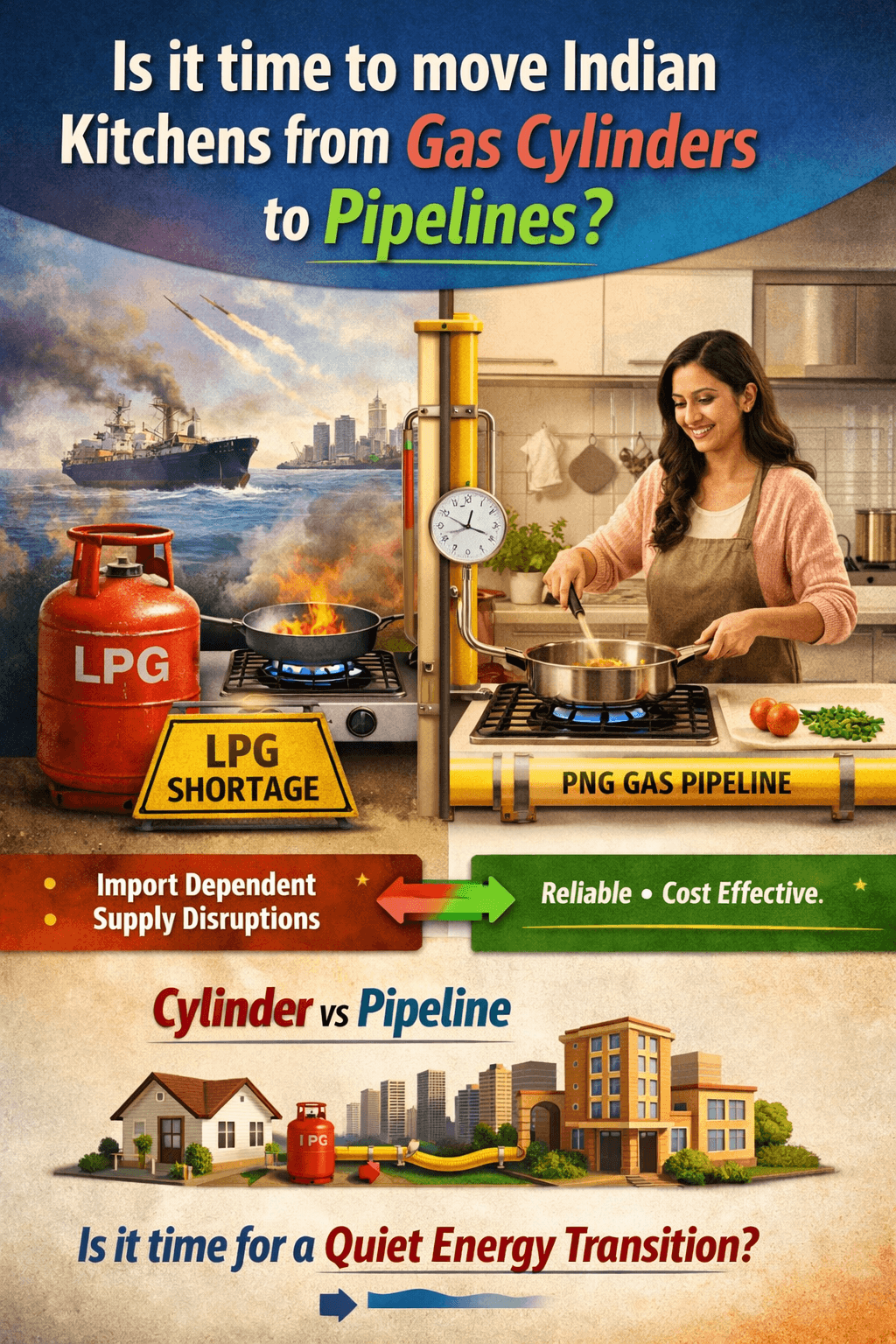
When a distant maritime chokepoint disrupts dinner plans in Indian households, it is a reminder that energy security is not an abstract policy concern but an everyday reality. The recent disruption in the Strait of Hormuz has once again exposed how deeply India’s cooking fuel ecosystem is tied to global supply risks.
India today relies on imports for roughly 60 percent of its LPG consumption, with a dominant 90% share historically routed through the Gulf. The resulting supply stress has led to panic bookings, supply prioritisation and administrative interventions, revealing how fragile the cylinder-based distribution model can become in times of geopolitical strain.
This moment calls for a structural rethink. The question is no longer whether LPG supplies can be temporarily stabilised, but whether India should accelerate a decisive shift towards piped natural gas.
The Cylinder Economy vs the Pipeline Economy
India’s LPG success story is undeniable. With nearly 33 crore connections, LPG has transformed household energy access. By contrast, PNG penetration remains tiny, with roughly 1 crore domestic connections concentrated in urban clusters. But the very architecture of LPG makes it vulnerable. It is a fuel that must be produced or imported, liquefied, transported, bottled and physically delivered.
PNG operates on a fundamentally different logic. Once pipelines are in place, gas flows continuously. There are no cylinders, no booking cycles and no last-mile logistics disruptions. It converts cooking fuel into a utility service rather than a supply chain exercise.
The recent crisis has sharply highlighted this difference. In urban centres like the National Capital Region, PNG demand has surged as households seek reliability over dependency.
The Consumer Economics of Switching
For households, the shift is not merely strategic but also economic. A standard LPG cylinder today costs around ₹900 without subsidy. In contrast, monthly PNG consumption typically translates to about ₹600–650 for comparable usage.
The savings are meaningful, particularly for middle-class households. More importantly, PNG eliminates the uncertainty of refill cycles and delivery delays. Billing is post-consumption, storage risks are lower and supply is uninterrupted.
This makes the transition not just economically rational but behaviourally attractive, especially in urban centres.
The Chemistry of Energy Security
The case for PNG also rests on its chemical composition. LPG consists largely of propane and butane, heavier hydrocarbons derived from crude oil refining. Its supply chain is therefore closely tied to oil markets.
PNG, composed primarily of methane, is a lighter hydrocarbon transported through pipelines or as liquefied natural gas. While India still imports a significant share of natural gas, these imports are more geographically diversified.
This diversification reduces dependence on a single chokepoint. It does not eliminate import reliance, but it distributes risk more effectively across suppliers and routes.
The Infrastructure Reality Check
Yet the transition to PNG is not without constraints. India has made substantial progress in building a national gas grid and expanding city gas networks. Over 1.6 crore PNG connections have been laid, but only about 1 crore are actively used.
This gap between connectivity and consumption highlights a deeper challenge. Infrastructure alone does not guarantee adoption.
In several cities, even where pipelines exist, consumer uptake remains muted. In some cases, operational inefficiencies limit supply. In others, behavioural inertia keeps households tied to LPG despite available alternatives.
The Adoption Paradox
This creates what may be called the adoption paradox. India has simultaneously underbuilt and underutilised its PNG ecosystem.
On one hand, large parts of the country, especially rural and semi-urban areas, lack pipeline infrastructure altogether. On the other, urban areas with network access struggle to convert connections into active usage.
This divide is also visible within households themselves. While younger families in urban residential societies have seamlessly adopted PNG as the default cooking fuel, their parents often continue to live in traditional households where LPG remains dominant, either because pipeline infrastructure has yet to reach or, even where available, behavioural inertia has limited adoption.
Bridging this gap needs more than infrastructure. It requires coordination to ensure reliable supply, faster installations and greater consumer awareness.
The Cost and Time Equation
Expanding PNG nationwide is capital intensive and time consuming. City gas distribution networks require large upfront investments in pipelines, metering systems and safety infrastructure. Urban deployment is particularly complex due to land access, regulatory approvals and coordination challenges.
Even with accelerated execution, a meaningful nationwide transition could take a decade or more. Rural expansion may take even longer due to weaker economic viability.
However, the long-term payoff lies in reduced logistics costs, improved energy efficiency and greater supply stability.
A Quiet Shift in India’s Kitchens
The disruption in the Strait of Hormuz has brought a distant geopolitical risk straight into India’s kitchens, turning what was once a policy aspiration into an everyday necessity. The push for households with PNG access to move away from LPG is not just about managing shortages, but about nudging families towards a more reliable way of cooking.
The policy response has been swift. Households with PNG access are being nudged to shift away from LPG, with parallel connections discouraged, while incentives like free gas credits and waived charges are accelerating adoption—positioning PNG as the preferred urban cooking fuel.
For many urban households, this shift is already intuitive—no more booking cylinders, no anxious waiting for deliveries, and a lighter monthly bill. While LPG will remain essential, especially in smaller towns and rural India, PNG offers city dwellers a simpler, steadier alternative.
The change will not happen overnight, but it does not need to. It begins with one household at a time choosing convenience over uncertainty. In that sense, India’s next energy transition may not feel like a grand policy shift at all, but a quiet, practical upgrade in everyday living—from cylinders to pipelines.
[The pdf copy of this article, authored by our Founder- Shri Mayank Mohanka, can be accessed in the pdf file section below]