

.jpg)
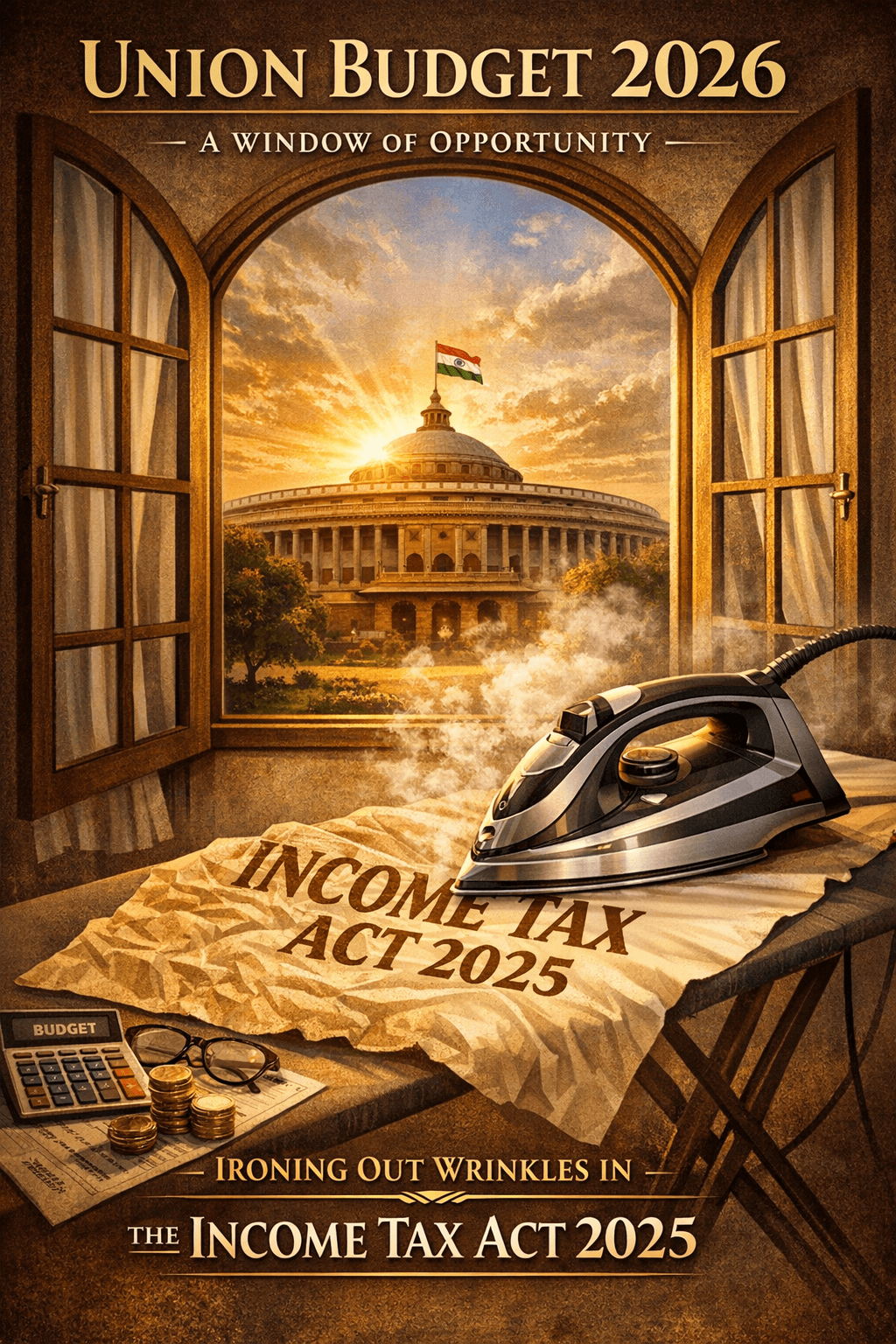
As the Union Budget 2026 approaches, Indian taxpayers face an unusual legislative conundrum. The familiar Income tax Act, 1961 is slated to be repealed with effect from 1 April 2026, and in its place, the Income tax Act, 2025 will come into force. This creates a rare interregnum. The Finance Bill, 2026 cannot meaningfully amend a statute that is about to disappear, yet the new law though already enacted and having received Presidential assent in August 2025 is not operational until the next tax year.
The new Act already exists in law. Only its enforcement is deferred. If any tax policy changes are announced in Budget 2026, legislative logic dictates that they will have to be stitched into the Income tax Act, 2025 itself, rather than retrofitted into a repealed framework.
This transitional moment therefore offers a unique opportunity. Instead of revisiting the architecture of the new Act, the Finance Bill, 2026 can be used as a corrective instrument to smoothen interpretational edges that have emerged from the drafting and structural shifts in the new Act. The Income tax Act, 2025 is a bold and largely welcome recodification. Yet, as with all major legislative rewrites, its first reading in practice reveals certain areas where drafting economy or policy rigidity may unintentionally produce uncertainty, inequity, or disproportionate consequences.
Thus the Union Budget 2026 brings with it a statutory window through the Finance Bill 2026, to make surgical course-corrections in select areas in the Income Tax Act, 2025, where drafting technique, definitional asymmetry, or disproportionate consequences may otherwise undermine certainty, equity, or long-settled jurisprudence.
Four such areas merit particular attention if the transition to the new tax regime is to be both orderly and credible.
(i) Transformation of GPU Compliance into Existential Risk
The most far-reaching structural shift in the charitable regime under the Income tax Act, 2025 lies in the treatment of entities advancing objects of general public utility.
Under the 1961 Act, the commercial receipts restriction was contained as a proviso to Section 2(15). Breach of the threshold resulted in denial of exemption for that year alone. Importantly, it did not constitute a ground for cancellation of registration under Section 12AB.
The 2025 Act relocates the commercial receipts restriction into a standalone substantive provision in Section 346. More significantly, Section 351(1)(b) classifies contravention of Section 346 as a specified violation justifying cancellation of registration itself.
This represents a decisive policy escalation. What was earlier a year specific denial of exemption now becomes a trigger for institutional extinction. Even a one time or incidental breach can result in permanent deregistration, irrespective of the bona fides or dominant charitable purpose of the institution.
The implications are particularly severe for chambers of commerce, development authorities, professional bodies, universities and non-governmental organisations that operate in complex economic environments. Activities such as trade fairs, land monetisation, certification programs or social enterprises can lead to episodic revenue spikes without altering the charitable character of the institution.
By collapsing the distinction between exemption denial and registration cancellation, Sections 346 and 351 risk imposing disproportionate consequences for compliance level lapses. The Finance Act, 2026 can restore balance by reintroducing proportionality, such as limiting cancellation to repeated or deliberate breaches, while retaining denial of exemption for isolated excesses.
(ii) Disruption of Shareholding Continuity Doctrine in Carry-forward of Losses by Companies
Section 79 of the Income tax Act, 1961 embodied a settled principle that losses of closely held companies should not be carried forward where there is a change in control. Crucially, the provision used the plural word “persons”, thereby recognising that continuity of ownership could be collective.
The corresponding provision under the Income tax Act, 2025 is Section 119(3). In a seemingly minor linguistic change, the provision replaces “persons” with “the person”, thereby introducing a singular formulation.
If read literally, Section 119(3) would permit carry forward of losses only where a single person held at least fifty one percent of voting power in both years. Such a construction would render the provision commercially impractical, as promoter control in closely held companies is typically exercised by groups rather than individuals.
There is nothing in the Notes on Clauses or parliamentary material to suggest that the legislature intended to abandon the doctrine of collective continuity that courts had consistently upheld under Section 79.
While courts may ultimately invoke Section 13(2) of the General Clauses Act to read the singular as including the plural, reliance on judicial rescue undermines certainty. A simple clarificatory amendment in the Finance Act, 2026 confirming that “person” includes a group of persons acting collectively would preserve doctrinal continuity and prevent unnecessary litigation.
(iii) The Connective “Where” in Substantive Provisions and the Risk of Turning Clarification into Condition
One of the most visible stylistic departures in the Income tax Act, 2025 is its move away from Explanations as a drafting device. In pursuit of brevity and linear readability, several Explanations under the 1961 Act have been absorbed into the main charging or allowance provisions through the connective word “where”.
This drafting shift is most clearly visible in Section 29(1)(b) of the Income tax Act, 2025 dealing with employer contributions to pension schemes, corresponding to Section 36(1)(iva) of the 1961 Act. Under the old law, the definition of salary was contained in a separate Explanation which clarified that salary included dearness allowance where the terms of employment so provided, but excluded other allowances. That Explanation was deliberately clarificatory. It never conditioned the availability of deduction.
Under Section 29(1)(b) of the 2025 Act, the same clarification is embedded in the main clause using the words “where such salary includes dearness allowance”. A literal reading now permits the interpretation that the deduction itself is available only where salary includes dearness allowance, rather than merely defining salary for the purpose of computing the ceiling .
This is not an isolated drafting risk. A more striking illustration emerges from the reconfiguration of Section 14A of the 1961 Act into Section 14 of the 2025 Act.
Under the 1961 Act, the Explanation to Section 14A was consciously framed as a clarificatory adjunct. Its purpose was to make it explicit that disallowance of expenditure could be made even in a year where no exempt income had actually been earned, so long as expenditure relatable to such income had been incurred. The Explanation expanded the scope of the section without disturbing its operative core.
In contrast, the Income tax Act, 2025 replaces this Explanation with a standalone provision in sub section (3) of Section 14, which reads that the provisions of the section shall apply in a case where expenditure has been incurred in relation to income which does not form part of total income, but such income has not accrued or arisen or has not been received during that tax year.
At first glance, this appears to be a mere structural modernisation. However, the syntactic shift and the connective logic materially alter the interpretational balance. The word “where” now frames the absence of exempt income as the operative condition for application of the section.
A literal reading of Section 14(3) therefore suggests that disallowance applies only in cases where exempt income has not been earned, rather than applying both where exempt income is earned and where it is not. This effectively inverts the doctrinal position that prevailed under the 1961 Act.
Under the old regime, the Explanation expanded the reach of Section 14A. Under the new regime, sub section (3) appears to confine Section 14 by making disallowance contingent upon the absence of exempt income. Such an outcome departs from settled legislative intent and opens the door to conflicting interpretations, precisely the uncertainty the simplification exercise sought to eliminate.
This example exposes a deeper doctrinal concern. Explanations and provisos under the traditional drafting architecture served distinct jurisprudential functions. Provisos carved out controlled exceptions. Explanations clarified ambiguities or affirmed interpretational extensions consistent with legislative intent.
By mechanically converting Explanations and provisos into co-equal subsections, the 2025 Act flattens this hierarchy. Every clause begins to appear normatively equivalent. This levelling dilutes the interpretive discipline courts have historically applied, particularly the principle that Explanations are clarificatory and not restrictive.
Similar risks arise in the computation of book profit under Section 206(1)(c) of the Income tax Act, 2025 corresponding to Section 115JB of the 1961 Act, where the inclusive definition of income tax has been embedded using “where income tax shall include” interest, surcharge and cess. Once again, a clarification risks being misconstrued as a qualifying condition.
The Act itself demonstrates that the connective can be used safely. In Section 19(1), Serial No. 6 relating to gratuity exemption, “where” is used purely to define variables in a formula. The problem therefore is not linguistic. It is contextual.
Given the propensity of tax administration to adopt literal readings, the Finance Act, 2026 should revisit provisions such as Sections 29(1)(b), 14(3), and 206(1)(c). Restoring or recasting the existing phrasing- “For the purpose of this subsection,….”, would preserve the simplification objective while preventing unintended doctrinal inversion.
(iv) Definition of ‘Relative’ and the Asymmetry Between Ascendants and Descendants
The definition of relative under Section 2(94) of the Income tax Act, 2025 broadly corresponds to Section 2(41) of the 1961 Act. While the structure and sequencing remain familiar, the new Act introduces a critical refinement by expressly stating that lineal ascendants include both paternal and maternal lines.
This express clarification brings welcome certainty with respect to maternal grandparents and other maternal ancestors. However, the same clarification is conspicuously absent in relation to lineal descendants. The provision does not state that lineal descendants include both paternal and maternal lines.
From a statutory interpretation perspective, this selective inclusion cannot be treated as accidental. When a legislature expressly qualifies one limb of a definition but remains silent on the other, the omission acquires significance. The consequence is a strong textual inference that lineal descendants are now confined to the paternal line alone.
This shift has direct implications under provisions such as Section 92(2)(m) of the Income tax Act, 2025, which corresponds to Section 56(2)(x) of the 1961 Act, dealing with taxation of gifts. While gifts received from maternal ascendants now clearly qualify for exemption, gifts from descendants through a daughter’s line may fall outside the definition of relative, exposing them to tax.
This represents a departure from the long-standing judicial understanding under the 1961 Act, where courts construed lineal descendants broadly and, in a gender, neutral manner. If such a narrowing of family relationships was not intended as a matter of policy, it warrants immediate clarification. If it was intended, it raises deeper questions of equity and consistency.
In either case, the Finance Bill, 2026 is the appropriate legislative moment to restore symmetry by extending the paternal and maternal clarification expressly to lineal descendants under Section 2(94).
Conclusion: Refinement as a Measure of Legislative Confidence
The Income tax Act, 2025 is, without doubt, a bold and largely well-judged attempt to reset India’s direct tax architecture. It reflects confidence, clarity of purpose, and a genuine desire to simplify a law that had grown unwieldy over decades. That underlying philosophy deserves to be carried forward.
Yet, confidence in legislation is not demonstrated by treating the text as infallible. It is demonstrated by the willingness to acknowledge where drafting choices, however well intentioned, may produce consequences that were never part of the original design. Large scale recodifications rarely reveal their fault lines on the drafting table. They reveal them only when the law meets lived commercial and institutional reality.
The issues highlighted above do not challenge the direction of reform. They do not call for reversals or rollbacks. They call for something far more modest and far more important: clarity where language has become conditional by accident, balance where compliance has been elevated into extinction, and continuity where settled principles risk being unsettled by syntax alone.
The Finance Act, 2026 therefore arrives at a moment that is both unusual and consequential. One law is on its way out. Another is waiting to step fully into force. In this narrow window, Parliament has the opportunity to smooth the edges of transition before interpretational disputes harden into litigation.
If handled thoughtfully, Budget 2026 can do more than announce rates and incentives. It can quietly reinforce trust in the new tax code by showing that reform is not a one-time event, but an ongoing dialogue between legislative intent and practical experience.
[This Article has also been published in Taxsutra and the pdf copy of the same is enclosed in pdf file tab below.]