

.jpg)
Setting the Context
Retrospective fiscal legislation has always occupied a constitutionally sensitive terrain. The power of Parliament to enact laws with retrospective effect is well recognised. Yet the hon’ble Supreme Court has consistently insisted that such power must operate within disciplined limits. Even Explanations, notwithstanding their nomenclature and professed clarificatory character, have never been accorded automatic retrospective operation by the hon’ble Apex Court. The Court has consistently insisted upon examining the true nature, legal effect and practical impact of such provisions, and has permitted retrospective applicability only where the amendment is found, in substance, to be genuinely declaratory rather than substantively transformative.
Against this settled backdrop, the Finance Bill, 2026 marks a significant doctrinal escalation. It does not merely insert Explanations couched as clarificatory in nature. It goes a step further by introducing altogether new sections and multiple substantive sub sections and seeks to confer upon them retrospective operation through explicit deeming fictions declaring that such provisions “shall always be deemed to have meant” or “shall always be deemed to have been inserted” from a back date extending in some instances as far as 1 October, 2009.
In recent decades of fiscal legislative practice, budget amendments of this nature and breadth, framed in such assertive terms of retrospective reconstruction, have been virtually unprecedented in Indian tax jurisprudence. On earlier occasions, Explanations were inserted and described as clarificatory, and even those were subjected to rigorous judicial scrutiny. This time, however, the legislative assertion appears to have travelled considerably further. The amendments begin with sweeping non obstante clauses, “notwithstanding anything contained in any judgment, order or decree of any court” and proceed to retrospectively redefine statutory architecture.
In this broader normative context, the Finance Bill, 2026 amendments raise not merely issues of institutional consistency and parity under the rule of law, but far deeper and more serious Constitutional concerns that go to the very balance between legislative power and judicial authority.
The answer must be sought in the time tested and settled jurisprudence of the Hon’ble Supreme Court, developed over decades, wherein the Court has consistently delineated the constitutional boundaries of retrospective legislative intervention. From early Constitution Bench pronouncements to more recent fiscal rulings, the Supreme Court has repeatedly affirmed that while retrospective amendments are within legislative competence, they must operate within defined constitutional limits and cannot transgress the discipline imposed by principles of defect removal, reasonableness and separation of powers.
The Constitutional Discipline on Retrospective Validation
(I) The Doctrine of Removal of Defect
The Supreme Court of India has consistently held that while the legislature possesses the plenary power to enact laws with retrospective effect, it cannot simply override or nullify a judicial decision by a bare declaration. A retrospective amendment is only valid if it cures the specific "basis, foundation, or defect" of the law upon which the judgment was founded.
In the landmark case of ‘Shri Prithvi Cotton Mills’ (1969) 2 SCC 283, a levy was invalidated by the courts on the ground of a statutory infirmity. The Legislature responded with a retrospective validating statute. The Constitution Bench of the hon’ble Supreme Court held that while the Legislature may change the law retrospectively and thereby remove the basis of a judicial decision, it cannot simply declare the judicial decision to be wrong. It must cure the defect or infirmity on which the judgment was founded. Once the defect is removed, the judgment loses its force because its foundation disappears.
This doctrine has since become the touchstone for assessing validating legislation. It draws a clear line between permissible defect curing and impermissible judicial override.
The principle was reaffirmed in the case of ‘Indian Aluminium Co. v. State of Kerala’ (1996) 7 SCC 637, where the Constitution Bench reiterated that retrospective validation is permissible only if the Legislature removes the cause of invalidity identified by the court. Legislative competence does not extend to exercising judicial power by simply nullifying judgments.
Then again in the case of ‘National Agricultural Cooperative Marketing Federation of India Ltd. v. Union of India’, (2003) 5 SCC 23, the Court observed that although Parliament has the power to amend law retrospectively, such power is subject to judicially recognised limitations. Retrospectivity must be reasonable and not excessive or harsh, and where legislation is introduced to overcome a judicial decision, the Legislature cannot use its power to subvert that decision without removing the statutory foundation on which it rests.
(II) Substance Over Legislative Label
The hon’ble Apex Court has consistently held that merely describing a provision as a "clarification" is not decisive of its true meaning and import. On this aspect, the Apex Court in ‘Virtual Soft Systems Ltd. v. CIT’ (2007) 289 ITR 83 (SC) declined retrospective effect to a provision that altered substantive rights, notwithstanding its declaratory phrasing.
The hon’ble Apex Court observed and held that even if the statute does contain a statement to the effect that the amendment is declaratory or clarificatory, that is not the end of the matter. The Court will not regard itself as being bound by the said statement in the statute itself, but will proceed to analyse the nature of the amendment and then conclude whether it is in reality a clarificatory or declaratory provision or whether it is an amendment which is intended to change the law and which applies to future periods.
This position of the law has also been subscribed to in ‘Union of India v. Martin Lottery Agencies Ltd.’ [2009] 20 STT 203 (SC) wherein it was stated that when a new concept of tax is introduced so as to widen the net, the same cannot be said to be only clarificatory or declaratory and therefore be made applicable retrospectively, even though such a tax was introduced by way of an explanation to an existing provision. It was further held that even though an explanation begins with the expression "for removal of doubts," so long as there was no vagueness or ambiguity in the law prior to introduction of the explanation, the explanation could not be applied retrospectively by stating that it was only clarificatory.
The hon’ble Supreme Court in the case of ‘Sedco Forex International Drill Inc. v. CIT’ (2005) 12 SCC 717/ 279 ITR 310
The hon’ble Apex Court in the case of ‘Sedco Forex International Drill Inc. v. CIT’ (2005) 289 ITR 310 (SC) emphasised that the label attached to an amendment is not decisive. The hon’ble Court clarified that even if an amendment or Explanation is worded as “for removal of doubts,” it cannot be deemed as retrospective in its operation if it substantively alters the law.
Thus, the guiding test of substance over linguistic form, remains the bedrock on which the Supreme Court, High Courts and Tribunals have leaned on when rejecting the retrospective operation of budget amendments. The Court must examine the substance and effect. If an amendment introduces substantive change, it cannot claim retrospective operation merely by describing itself as clarificatory.
(III) Fairness and Predictability
In the case of ‘CIT v. Vatika Township Pvt. Ltd.’ (2014) 367 ITR 466 (SC), the Constitution Bench of the hon’ble Apex Court articulated fairness and predictability as foundational values in tax law. Amendments imposing new burdens are ordinarily prospective. Retrospective imposition must be justified by compelling considerations and cannot arbitrarily unsettle legitimate expectations.
These binding judicial precedents and authorities collectively establish that retrospective legislation must genuinely cure a defect, must not merely reverse judicial interpretation, must not be excessive or arbitrary and must respect fairness and predictability, and must not extinguish vested rights without constitutional justification.
In ‘CIT v. Essar Teleholdings Ltd.’, (2018) 3 SCC 253, the hon’ble Supreme Court held that Rule 8D of the Income-tax Rules, prescribing the method for computing disallowance under Section 14A, is prospective and applicable only from assessment year 2008-09 onwards. The Court rejected the Revenue’s contention that the Rule was merely procedural or clarificatory, observing that it introduced a substantive computational mechanism. It reaffirmed that a provision creating new burdens or altering legal consequences cannot be treated as retrospective unless the statute clearly and expressly mandates such operation.
Constitutional Examination of the Finance Bill, 2026 Retrospective Amendments
It is against this settled jurisprudential backdrop that the retrospective amendments proposed in the Finance Bill, 2026 must be evaluated.
(a) Reassessment Jurisdiction, Section 151A and the Faceless Mandate
The Finance Bill, 2026 proposes to insert an altogether new section 147A in the Income tax Act, 1961, which interestingly reads as under:
“Notwithstanding anything contained in any judgment, order or decree of any court or in section 151A or in any scheme framed thereunder, for the removal of doubts, it is hereby clarified that the Assessing Officer for the purposes of sections 148 and 148A shall mean and shall always be deemed to have meant to be an Assessing Officer other than the National Faceless Assessment Centre…”
This section is deemed to be inserted retrospectively from 1 April 2021.
The controversy surrounding reassessment jurisdiction under Sections 148 and 148A must be examined in the light of the legislative architecture consciously introduced by Parliament.
The Taxation and Other Laws (Relaxation and Amendment of Certain Provisions) Act, 2020 inserted Section 151A into the Income-tax Act, 1961 with effect from 1 April 2021. Section 151A empowered the Central Government to make a scheme for the purpose of:
(a) assessment, reassessment or recomputation under Section 147;
(b) issuance of notice under Section 148;
(c) conducting enquiries, issuance of show cause notice or passing of order under Section 148A; and
(d) sanction under Section 151 for issuance of notice under Section 148.
The statutory object was expressly articulated. The scheme was to impart greater efficiency, transparency and accountability by eliminating interface between the income tax authority and the assessee to the extent technologically feasible, optimising resource utilisation through functional specialisation and introducing team based dynamic jurisdiction.
Pursuant to this statutory empowerment, the Central Government notified the e-Assessment of Income Escaping Assessment Scheme, 2022, vide Notification No. 18/2022 dated 29 March 2022. The Scheme expressly provided that assessment, reassessment or recomputation under Section 147 and issuance of notice under Section 148 shall be carried out through automated allocation in accordance with risk management strategy and in a faceless manner to the extent provided in Section 144B.
The statutory design therefore was not confined to post notice assessment proceedings. It extended to issuance of notice under Section 148 and to enquiries under Section 148A. The legislative text of Section 151A read with the notified Scheme consciously integrated issuance of notice within the faceless ecosystem.
It was on the basis of this statutory framework that various High Courts examined reassessment notices issued by jurisdictional Assessing Officers outside the faceless architecture. In quashing such notices, the courts did not invent a new interpretive standard. They relied upon the text of Section 151A, the notified Scheme and the declared objective of eliminating interface and introducing automated allocation.
Recently, during the hearing of the ‘JAO-FAO’ batch of cases listed before a three judge Bench led by the Hon’ble Chief Justice of India, the learned Additional Solicitor General informed the hon’ble Apex Court that the retrospective amendments proposed in the Finance Bill, 2026 would cover the batch and render the issue infructuous once Parliament passes the law. It was further submitted that another amendment was likely in Section 150 to ensure automatic revival of notices pursuant to the retrospective amendment. The Court was also informed that assessments aggregating approximately Rs. 15.5 lakh crore were in limbo on account of four jurisdictional and procedural issues now sought to be clarified through retrospective amendments.
The Explanatory Memorandum to the Finance Bill, 2026 now asserts that it was never the intention of the Legislature to mandate the National Faceless Assessment Centre or its assessment units to involve themselves in pre assessment enquiry or issuance of notice. The newly inserted Section 147A retrospectively declares that the Assessing Officer for the purposes of Sections 148 and 148A shall always be deemed to have meant an officer other than the National Faceless Assessment Centre.
This legislative assertion, however, must be reconciled with the plain text of Section 151A and the Scheme framed thereunder. Parliament expressly empowered the Government to frame a scheme for issuance of notice under Section 148 and for conducting enquiries under Section 148A in a faceless manner. The notified Scheme expressly covered issuance of notice under Section 148 and provided for automated allocation.
In this backdrop, it is difficult to characterise the High Court judgments as having misread legislative intent. On the contrary, the courts appear to have enforced the statutory architecture as consciously designed and publicly proclaimed.
As per the settled jurisprudence, the Legislature may remove the defect on which a judgment rests. If the defect identified by courts was non compliance with the faceless mandate as enacted under Section 151A and the notified Scheme, retrospective insertion of Section 147A does not cure ambiguity. It redefines jurisdictional allocation and declares that the law always meant something different from what Section 151A and the Scheme appeared to provide.
The constitutional vulnerability lies precisely in this reconstruction of intent. The original legislative scheme consciously extended faceless architecture to issuance of notice. Courts enforced that scheme. The retrospective amendment now asserts that such was never the intention.
Such a shift invites scrutiny under the doctrine of removal of defect. The question that will inevitably arise is whether the amendment genuinely corrects a statutory lacuna or retrospectively neutralises judicial enforcement of Parliament’s own design.
Section 151A and the faceless reassessment scheme were introduced as structural reforms with explicit legislative and executive endorsement. Courts that invalidated reassessment notices did so by interpreting this architecture as enacted.
The critical enquiry is whether courts identified a drafting defect or merely enforced the statutory design. There is no indication that the adverse judgments rested upon ambiguity requiring cure. Rather, they appear to have arisen from non compliance with the scheme.
If so, the retrospective amendment does not remove a defect. It reallocates jurisdiction by declaring that the Assessing Officer “shall always be deemed” to have meant something different. This contradicts the earlier legislative articulation and public representation of intent.
Such retrospective rewriting cannot be equated with curing a defect. It amounts to neutralising judicial enforcement of the Legislature’s own earlier mandate.
(b) DIN Validation and Institutional Consistency
The Finance Bill proposes insertion of Section 292BA with retrospective effect from 1 October 2019 and it reads as under:
“292BA. Notwithstanding anything contained in any judgment, order or decree of any court, for the removal of doubts, it is hereby clarified for the purposes of section 292B that no assessment under any of the provisions of this Act shall be invalid on the ground of any mistake, defect or omission in respect of quoting of a computer generated Document Identification Number, if the assessment order is referenced by such number in any manner.”
The DIN amendment must be examined in its full institutional context.
With a view to bring greater transparency in the functioning of tax administration, improve service delivery and maintain a proper audit trail of communications, the CBDT, in pursuance of the announcement of the Hon’ble Finance Minister, issued Circular No. 19 of 2019 dated 14 August 2019. The Circular mandated that all communications issued on or after 1 October 2019 shall carry a computer generated Document Identification Number duly quoted in the body of such communication. It further stated in clear and unambiguous terms that any communication not in conformity with the prescribed guidelines shall be treated as invalid and shall be deemed to have never been issued.
This mandate was publicly endorsed. The hon’ble Finance Minister had stated that any income tax or GST communication issued without DIN after 1 October 2019 would be invalid and could be thrown in the Dustbin. The then Revenue Secretary reiterated the binding nature of this reform. The Circular was issued under Section 119 and therefore bound the Department.
Relying upon this Circular, the Hon’ble Delhi High Court in CIT (International Taxation) v. Brandix Mauritius Holdings Ltd., (2023) 456 ITR 34, quashed a DIN less assessment order. The Revenue challenged this decision before the hon’ble Supreme Court in SLP Civil Diary No. 46964/2023, and the hon’ble Apex Court granted interim stay, observing that non mentioning of DIN may be an irregularity but not necessarily an illegality.
The DIN mandate was introduced as a transparency reform and categorically represented as mandatory. Courts enforced that representation. The proposed amendment retrospectively lowers the consequence of non compliance.
As per the settled jurisprudence, in order to render validity and legality to the retrospective amendments being made to neutralise the adverse judgements, the Legislature must remove the defect on which the judgment was founded. In the Brandix line of cases, the defect identified was non compliance with a binding circular. The amendment does not cure ambiguity in the Circular. It alters the consequence of non compliance. Under Sedco Forex, the mere invocation of “for removal of doubts” cannot determine character. Under Vatika Township, fairness and legitimate expectation require stability in compliance standards.
If executive mandates are introduced in the name of reform and solemnly assured to taxpayers, retrospective dilution because of revenue impact raises concerns of institutional consistency. The doctrine of removal of defect does not bend to quantum.
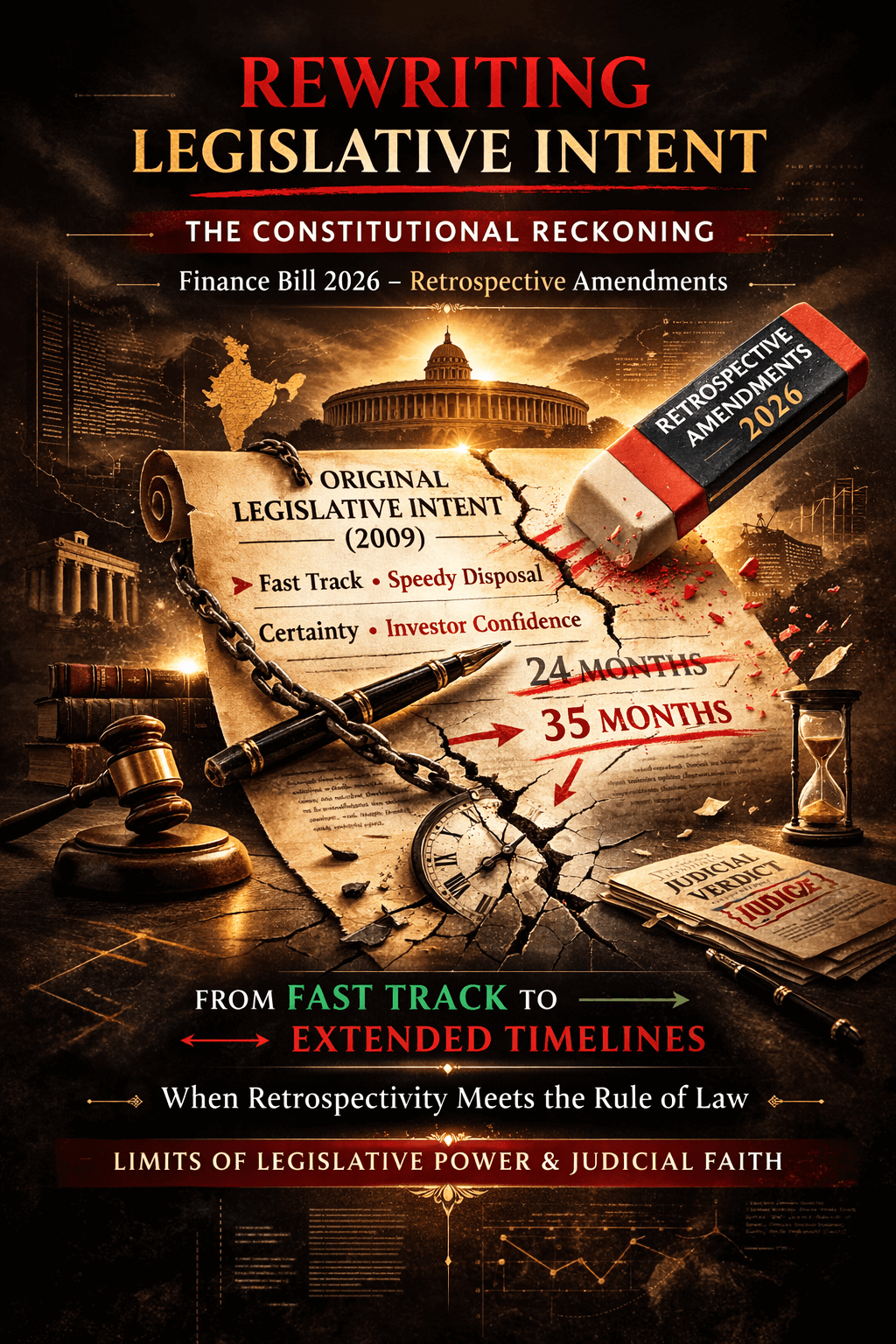
(c) Retrospective Recasting of Section 144C and Sections 153 / 153B: From Fast Track Resolution to Extended Timelines
The retrospective amendments proposed in respect of Section 144C and its interplay with Sections 153 and 153B must be examined in the light of the original legislative intent behind the introduction of Section 144C by the Finance (No. 2) Act, 2009.
Section 144C was not an incidental procedural insertion. It was a conscious structural reform aimed at providing a fast track and expeditious dispute resolution mechanism for eligible assessees, particularly multinational enterprises and non residents whose cases often involved high stakes transfer pricing adjustments.
The Explanatory Memorandum to the Finance (No. 2) Act, 2009 articulated the objective in unequivocal terms under the heading “Provision for constitution of alternate dispute resolution mechanism.” It recorded:
“The dispute resolution mechanism presently in place is time consuming and finality in high demand cases is attained only after a long drawn litigation till Supreme Court. Flow of foreign investment is extremely sensitive to prolonged uncertainty in tax related matter. Therefore, it is proposed to amend the Income-tax Act to provide for an alternate dispute resolution mechanism which will facilitate expeditious resolution of disputes in a fast track basis.”
The legislative intent, therefore, was twofold. First, to reduce prolonged uncertainty in high demand cases involving multinational corporations. Second, to assure foreign investors that India’s tax dispute framework would provide timely resolution without the necessity of prolonged appellate litigation.
Section 144C accordingly introduced a draft assessment stage, followed by reference to the Dispute Resolution Panel, with clearly demarcated and compressed timelines. Sub section (4) and sub section (13) provided that the final assessment order shall be passed within one month from the end of the month in which the acceptance is received or DRP directions are received, notwithstanding anything contained in Section 153. The use of the non obstante clause at that stage was deliberate. It created a distinct and self contained timeline regime for DRP cases, reflecting the fast track objective.
In view of the clearly articulated legislative intent of expeditious and speedy disposal, the non obstante clause referring to the overarching limitation under Section 153, which at the relevant time prescribed an outer limit of twenty four months, was logically intended to accelerate the assessment process rather than to expand it. The purpose was to ensure that once the draft stage or DRP directions were triggered, the Assessing Officer was obligated to conclude the proceedings within the compressed one month window, even if substantial time under the broader Section 153 limitation was still available. To interpret the non obstante clause as enabling the Assessing Officer to complete DRP assessments beyond the structured limitation framework, or to effectively enlarge the overall time span, would run contrary to the very fast track objective that animated the insertion of Section 144C. The legislative design was to compress timelines and instill certainty, not to create an extended adjudicatory window under the guise of harmonisation with Section 153.
The hon’ble Madras High Court in the case of CIT vs. Roca Bathroom Pvt Ltd, 2022 SCC Online Madras 8777, and hon’ble Supreme Court Justice Nagarathna J, in the case of ‘ACIT v. Shelf Drilling Ron Tappmayer Ltd. [TS-460-SC-2025-TP], while interpreting the interplay between Section 144C and Sections 153 and 153B, read the statutory scheme as enacted. Where assessments were not completed within the overall limitation period prescribed under Section 153, the hon’ble courts invalidated such orders. The judicial reasoning was rooted in the statutory text and in the discipline of limitation.
The Finance Bill, 2026 now inserts sub sections (4A), (4B), (13A) and (13B) into Section 144C with retrospective effect from 1 April 2009 and 1 October 2009. These provisions declare that where a draft order is forwarded within the time allowed under Section 153 or Section 153B, the further time available to the Assessing Officer to complete the assessment shall be governed by sub sections (4) and (13), and shall always be deemed to have been so governed. Parallel amendments in Sections 153 and 153B retrospectively deem the draft order to have been made within the prescribed time.
The cumulative effect of these retrospective amendments is significant. They effectively extend the permissible outer time limit for completion of DRP assessments. In practical terms, the maximum timeline, which earlier operated within an overall 24 month structure, now stands expanded to approximately 35 months when the draft stage and DRP process are aggregated.
This extension operates retrospectively from 2009 onwards.
The constitutional and doctrinal tension lies here. The original legislative intent in 2009 was to create an expeditious and fast track mechanism to inspire investor confidence and minimise prolonged uncertainty. The Explanatory Memorandum expressly emphasised speed and finality. The architecture of Section 144C was built around that objective.
The retrospective amendments now validate longer timelines and effectively enlarge the permissible window for completion of such assessments from inception. What was conceived as a fast track mechanism is retrospectively reshaped into a more extended adjudicatory process.
While the Legislature is competent to amend limitation provisions prospectively, the retrospective enlargement of timelines from 2009 onward raises a more nuanced question. If courts invalidated certain assessments on the ground that they were completed beyond the overall statutory limitation as originally framed, and the Legislature now retrospectively reconstructs that limitation framework, the constitutional enquiry for the validity of such rewriting of the legislative intent becomes inevitable. Is the amendment curing a defect in drafting, or is it neutralising judicial enforcement of the original fast track design?
The very rationale that justified insertion of Section 144C in 2009, namely expeditious resolution and reduction of uncertainty for foreign investors, appears to stand diluted by retrospective extension of permissible timelines. The constitutional debate therefore is not confined to technical limitation computation. It concerns fidelity to declared legislative intent.
When a statutory provision introduced to ensure speedy disposal is retrospectively amended in a manner that expands the adjudicatory window by nearly eleven additional months, the amendment must be examined not merely as a clarification, but as a substantive alteration of the original legislative balance between expedition and finality.
Whether such retrospective expansion can be characterised as removal of defect, or whether it represents reconstruction of the very objective that animated the provision’s birth, is a question that courts may ultimately be called upon to decide.
Concluding Reflections
In addition to the above analysis of the constitutional validity of the proposed retrospective amendments in the light of well-established jurisprudence, it is also necessary to address the more basic moral narrative that is repeatedly invoked, namely that substantial assessments ought not to be quashed on so-called hyper-technical legal grounds. At the outset, the very characterisation of these issues as hyper-technical or merely procedural is a misnomer. Such a description understates their true nature and fails to acknowledge that many of these lapses pertain to jurisdiction, statutory mandate and compliance with structural safeguards consciously introduced by the Legislature itself.
The constitutional discourse surrounding these retrospective amendments must also be viewed through the lens of parity and institutional symmetry. In the tax ecosystem, compliance obligations imposed upon taxpayers are treated as inviolable. Filing of income tax returns within prescribed deadlines, furnishing of tax audit reports, making investments within statutory timelines for capital gains roll over benefits, filing prescribed forms for exemptions or deductions, submission of TDS returns, and adherence to statutory limitation periods are all regarded as mandatory conditions. Failure to comply often attracts penal consequences, denial of deductions, disallowance of losses, levy of interest or even prosecution. The very same revenue authorities and their standing counsels advocating such unprecedented retrospective amendments, ironically, always contend that such statutory timelines are not mere procedural technicalities but substantive requirements that determine rights and liabilities of the taxpayers.
Imagine, if a large number of taxpayers were to simultaneously default in filing their returns within the stipulated due dates and thereafter contend that such delay is merely a procedural lapse that ought not to result in denial of carry forward of losses or imposition of interest, such a plea would find little judicial sympathy. The statutory scheme is clear. Compliance within prescribed timelines is treated as jurisdictional in many contexts and not as a curable irregularity.
The same principle of constitutional parity must necessarily apply to revenue authorities. Deadlines for issuance of notices, compliance with jurisdictional allocation under a faceless scheme, adherence to the DIN mandate introduced as a transparency safeguard, and observance of statutory limitation under Sections 144C, 153 and 92CA of the Income Tax Act, 1961, are not ornamental or decorative provisions. They define jurisdiction. They determine validity. They were introduced and widely publicised as taxpayer friendly measures intended to enhance transparency, eliminate arbitrariness and promote accountability.
To characterise these requirements as mere hyper-technical objections once adverse judicial consequences follow is to invert the compliance paradigm. Jurisdictional defects are not superficial lapses. They go to the root of authority. When Parliament or the Executive designs procedural architecture as a safeguard, it is not open to retrospectively dilute such safeguards solely on the ground that revenue stakes are high.
The repeated emphasis placed before courts on the magnitude of assessments allegedly in limbo, whether quantified at Rs. 15.5 lakh crore or otherwise, cannot itself justify retrospective rewriting of legislative history. Constitutional discipline does not fluctuate with fiscal quantum. If compliance discipline is non negotiable for taxpayers, it must equally bind the State.
To hold otherwise would create an asymmetrical system in which statutory obligations are rigid for the citizen but elastic for the sovereign. Such asymmetry is difficult to reconcile with the rule of law. The moral appeal that revenue stakes are enormous cannot override constitutional doctrine. What would be the response if taxpayers collectively argued that statutory timelines imposed upon them should be relaxed retrospectively because the stakes for them are equally significant? The answer is self evident.
The constitutional commitment to equality before law and equal protection of laws under Article 14 requires that statutory mandates be applied with even handedness. Jurisdictional safeguards introduced as structural reforms cannot be retrospectively downgraded to hyper-technicalities merely because their enforcement has fiscal consequences. The doctrine of removal of defect cannot become a vehicle for selective relaxation of compliance discipline.
The DIN mandate was introduced through CBDT Circular No. 19 of 2019 with the imprimatur of the Hon’ble Finance Minister, the then Revenue Secretary and the Chairman of the CBDT. Public press releases underscored the transparency objective. Similarly, Section 151A and the faceless reassessment scheme were enacted with full parliamentary authority as structural reforms intended to eliminate personal interface and enhance systemic integrity. Press statements and parliamentary debates reflected a clear and emphatic legislative intent.
In such a context, the assertion that the legislative intent “was always otherwise” presents a serious conceptual difficulty. High revenue stakes, if any, ought to have been evaluated at the time of introducing such mandates. Taxpayers and tax professionals did not demand the faceless regime or the DIN architecture. These were executive and legislative initiatives introduced in the name of reform and transparency. If such mandates were later found inconvenient in implementation, the question that naturally arises is why they were introduced in that form at all.
The Common Thread Across the Retrospective Amendments
When the retrospective amendments of the Finance Bill 2026, are viewed together, a discernible and constitutionally significant pattern emerges. In each instance, the original statutory architecture or executive mandate was clearly conceived, expressly articulated and publicly defended as part of a structured reform. The High Courts, in the judgments that followed, did not innovate new standards or impose extraneous conditions. They interpreted and enforced the statutory framework in accordance with its text, scheme and declared objective.
The difficulty arose only when such faithful enforcement resulted in adverse revenue consequences. The legislative response now takes the form of retrospective amendments declaring that the law shall always be deemed to have meant something different from what the statutory language and contemporaneous executive articulation conveyed.
This sequence of events raises concerns that travel beyond routine legislative correction. The constitutional significance lies in the fact that the courts were not distorting legislative purpose; they were giving effect to it. While Parliament unquestionably retains the power to cure defects and to amend the law retrospectively within constitutional bounds, it cannot retrospectively rewrite legislative history by deeming that its earlier intent was other than what its own text and formal explanations unmistakably expressed.
In the final analysis, the legitimacy of retrospective intervention rests not upon the strength of its drafting but upon its fidelity to constitutional doctrine. Where amendment shades into reconstruction of declared intent, the scrutiny it invites is correspondingly deeper and more exacting.
This moment calls for institutional introspection. The constitutional question is whether retrospective insertion of substantive provisions, accompanied by emphatic deeming language, can legitimately be characterised as curing a statutory defect, or whether it amounts to retrospective neutralisation of judicial enforcement of Parliament’s own earlier design.
[The pdf copy of this Article is also enclosed below in pdf file section.]
[This Article, authored by our Founder- Shri Mayank Mohanka, FCA, has also been published in Taxsutra].